

AI-POWERED FUNCTIONAL EQUIVALENCE TESTING

Functional Validation for Every Stage of Application Modernization
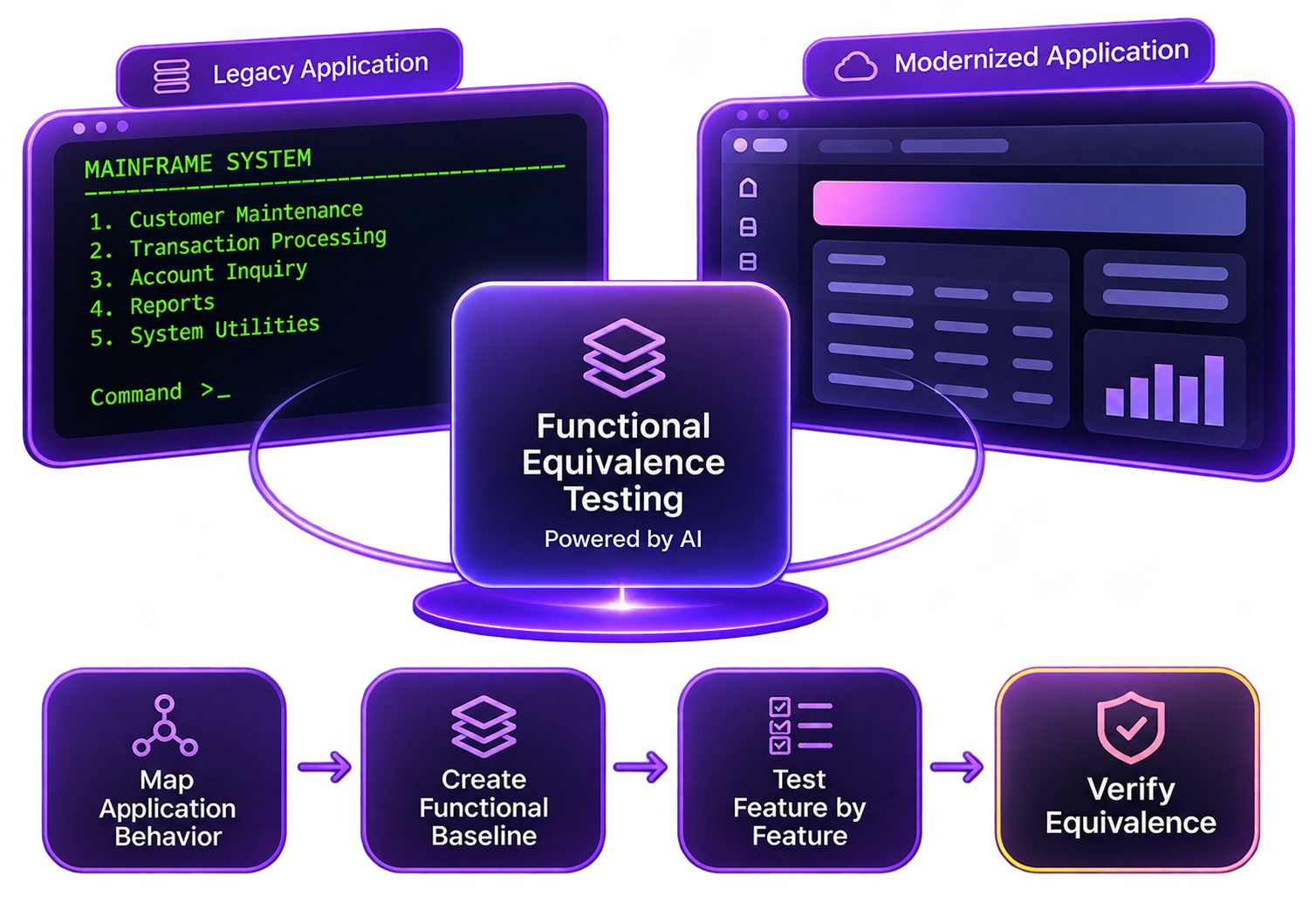
Discover application behavior, document business logic and compare functional outcomes across legacy and modernized systems.
Mainframe to web. Client-server to cloud. Monolith to microservices. Verified.
Why Current Approaches Fall Short
Code Conversion Got Faster. Proving It Still Works Didn’t
AI-assisted tools accelerate legacy code conversion. But validating existing business rules, calculations and workflows across modernized applications remains a challenge.
That’s why we built Zyrix Functional Equivalence Testing (FET), to make functional validation part of every modernization journey.

How Legacy Modernization Assurance Works
Modernize the technology. Preserve the business intent.
Prove the right business behaviour survives modernization: what’s kept, changed, retired and new. Follow one policy billing system from mainframe to cloud.
Understand what the legacy system really does.
ZEAP reads the code, data and behaviour to find the business logic worth keeping.
Decades of business logic live in legacy code, and much of it was never documented.
- Premium calculationRule
- Late-payment feeRule
- Policy renewalWorkflow
- Nightly billing runBatch
- SME review of 3 undocumented rules
- Guided exploration of 2 workflows
- Observed behaviour recorded
| Capability | Intent | Validated as |
|---|---|---|
| Premium calculation | Retained | Same result as legacy |
| Policy renewal journey | Refactored | Same outcome, 3 screens instead of 6 |
| Fax confirmations | Retired | Excluded from comparison |
| Self-service payments | New | Own acceptance criteria |
- Premium calculation14 tests
- Policy renewal22 tests
- Self-service paymentsGap: no API test
| Business outcome | Legacy | Modern | Result |
|---|---|---|---|
| Annual premium | 1,284.60 | 1,284.60 | Match |
| Late-payment fee | 25.00 | 25.00 | Match |
| Billing schedule | Monthly × 12 | Monthly × 12 | Match |
| Loyalty discount | 10% | 12% | Difference |
- RefactoredRenewal in 3 screens instead of 6Same outcome
- NewSelf-service paymentMeets criteria
- RetiredFax confirmationNot a defect
- UIRenewal submitted in web appOK
- API/premium returns 12% discountCheck
- RulesDiscount table v2 loaded (2025 rates)Cause
The discount table was migrated with new 2025 rates. Legacy still uses the 2024 rates.
- Policy renewalReady
- Premium billing1 defect
- Claims payoutIn progress
Illustrative console with sample data. The walkthrough plays automatically; select any step or tag to explore.
Modernization Approaches
One Standard of Validation. Every Modernization Path
From infrastructure migration to complete application replacement, verify that existing functionality carries over.
For the Teams Behind Every Migration
Functional Clarity from Migration to Sign-off
Each team gets the validation evidence it needs to assess application behaviour, review functional changes and move through modernization with confidence.
Sign-off
Modernization leaders
See functional gaps before cutover.
Gap reportQA and test leaders
Test against actual application behaviour.
Behaviour test resultsBusiness owners and SMEs
Verify that business rules carry over.
Rule comparisonSystem integrators
Share evidence at every project milestone.
Milestone evidence pack
Built With You, For You
Your Code. Your Data. Your Control.
Deploy within your security perimeter, connect to your pipelines, and modernize at your pace with complete data privacy and sovereignty.
On-demand FET in your pipeline
Run tests when it fits your release workflow, not on someone else’s schedule.
Test what matters automatically
Create relevant test scenarios and validations from your application’s code and data.
Use your own data securely
Run tests on your data within your environment. No data leaves your control.
Evolve on your own terms
Modernize, replatform or refactor at your pace, with a consistent safety net.
FAQs
Legacy modernization assurance FAQs
If the reference PDF does not contain specific questions, please review these architectural placeholders.
Legacy modernization assurance is the practice of proving that a modernized application preserves the functionality and business behavior of the system it replaces. It combines discovery of the legacy application, a functional baseline of expected behavior, and validation of the new application against that baseline, including end-to-end business processes.
Migration testing usually checks that data moved and the new system runs. Modernization assurance goes further. It checks that the new application behaves like the old one, rule by rule and workflow by workflow, and it reports exactly what is fully matched, partially matched or missing.
Functional equivalence testing verifies that a modernized application delivers the same functional outcomes as the original for the same inputs and scenarios. The legacy application serves as the reference, and any difference in features, calculations or business rules is flagged for investigation.
No. Zyrix focuses on discovery and validation. Your team, system integrator or code-conversion tool builds the replacement application. Zyrix independently verifies that it carries forward what the legacy application did.
Documentation helps but is not required. AI-led discovery analyzes the legacy application itself to understand its functionality and business behavior. [CONFIRM whether source code access is required, optional or not needed.]
[CONFIRM list, e.g. mainframe (COBOL/CICS), IBM i (RPG), client-server (PowerBuilder, VB6, Oracle Forms) and packaged applications, moving to web, cloud-native, microservices or SaaS platforms.]
Yes. The legacy mainframe application serves as the functional reference, and its modernized web application is validated against that baseline, even though the technology, interface and architecture are completely different.
Yes. Validation extends beyond individual features to how the modernized application works within connected systems, APIs, data flows and end-to-end business processes.
[CONFIRM typical range and what drives it, e.g. application size, number of workflows, SME availability.]
The application has changed. Has the business logic?
Understand your legacy application. Validate its modernized counterpart. Go live knowing what works and what still needs attention.