


Blog

AI for Data Quality: How It Works, Use Cases, and How to Start

AI for data quality means using machine learning and AI models to find, prevent, and fix problems in your data automatically. Instead of engineers writing and maintaining thousands of manual rules, AI profiles the data, learns what “normal” looks like, suggests quality checks, flags anomalies, and helps clean errors such as duplicates, missing values, and inconsistent formats.
Key Takeaways
- AI moves data quality from manual, rule-by-rule checking to continuous, automated monitoring that scales with your data.
- The six most practical uses are profiling, rule generation, anomaly detection, duplicate matching, cleansing, and cross-system reconciliation.
- AI works best with people in the loop: it finds and suggests, and your team approves changes to critical data.
- Start with one high-value dataset, measure a baseline, and expand once the results are proven.
Not to be confused with “data quality for AI”, which is about preparing clean data for AI models. This article is about using AI to improve the quality of any data.
Why Rule-Based Data Quality Can No Longer Keep Up
Traditional data quality depends on people writing rules: “email must contain @”, “order amount must be positive”. That worked when a team managed a few dozen tables. Today, data arrives from hundreds of sources, schemas change weekly, and many problems (a slow drift in values, a near-duplicate customer) are not things anyone thought to write a rule for.
The cost of falling behind is growing. Gartner predicts that through 2026, organizations will abandon 60% of AI projects that are not supported by AI-ready data, and its survey of 1,203 data management leaders found that 63% of organizations either lack the right data management practices for AI or are unsure. In the 2026 State of Data Integrity and AI Readiness report from Drexel LeBow and Precisely, data quality was the most common data integrity priority, cited by 51% of data leaders.
Traditional vs. AI-Driven Data Quality
| Traditional (rule-based) | AI-driven | |
| How checks are created | Engineers write each rule by hand | AI suggests rules from the data’s structure and history |
| What it catches | Only problems someone anticipated | Known problems plus unexpected anomalies and drift |
| Duplicate detection | Exact matches | Fuzzy matches (typos, formats, name variations) |
| Scaling to new sources | Slow: new rules for every table | Fast: profiles new sources automatically |
| When issues are found | Often after a report or customer complaint | Continuously, as data arrives |
| Who can use it | Mostly engineers writing SQL | Engineers, plus business users in plain language |
6 Ways AI Improves Data Quality
1. Automated data profiling
AI scans every table and column to summarize data types, value ranges, null rates, patterns, and relationships between fields. What took an analyst days of manual queries takes minutes, and it runs again whenever the data changes.
2. Quality rule generation
From the profile, AI suggests checks you can accept, edit, or reject. Example: it notices that postal_code is always 6 digits for Indian addresses and suggests a validation rule, or that ship_date is never earlier than order_date.
3. Anomaly detection
AI learns the normal behavior of each dataset (daily row counts, typical values, freshness) and alerts when something changes. Example: a nightly sales feed that normally loads 50,000 rows suddenly loads 4,000, or average order value doubles overnight because a currency field switched from rupees to paise.
4. Duplicate detection and matching
Fuzzy matching finds records that refer to the same customer, product, or supplier even when spelling, formatting, or abbreviations differ, such as “Priya Sharma” and “priya sharma” with the same phone number written two ways.
5. Data cleansing and standardization
AI corrects common issues such as inconsistent formats, misspelled categories, and invalid values, using reference data and learned patterns. For critical fields, the safest setup is for AI to propose fixes and a person to approve them.
6. Validation and reconciliation across systems
When data moves between systems (an ERP to a warehouse, or source to target in an ETL job), AI-assisted checks compare both sides, catch missing or mismatched records, and flag schema changes before they break reports.
A Before-and-After Example
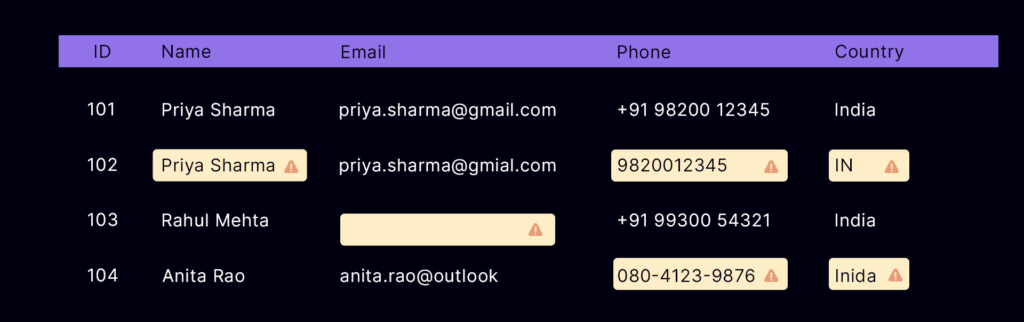
Customer data before AI – assisted cleanup
What an AI data quality tool would flag:
- Duplicate: rows 101 and 102 match on the normalized phone number and name; row 102’s email has a likely typo (“gmial”). Suggested action: merge, keeping row 101’s email. A person approves the merge.
- Missing value: row 103 has no email. AI does not invent one; the record is routed for completion.
- Invalid format: row 104’s email has no domain ending and is flagged for verification.
- Inconsistent values: “IN” and the misspelling “Inida” are standardized to “India”, and phone numbers are converted to one international format.
The result: three clean records instead of four messy ones, one record sent for completion, and new rules (valid email format, standard country names) saved so the same issues are caught automatically next time.
Benefits and Limits of AI for Data Quality
Benefits
- Coverage: checks every table and column, not just the ones someone wrote rules for
- Earlier detection: issues are caught as data arrives, before they reach dashboards or AI models
- Less manual work: fewer hand-written rules and less spreadsheet-based reconciliation
- Wider access: business users can ask about data quality in plain language
Limits to plan for
- It learns from your history: if bad data has been normal for months, AI may treat it as normal. Review the first baselines it learns.
- False alarms: poorly tuned anomaly detection creates alert fatigue. Start with sensitive thresholds on a few critical datasets, then tune.
- It should not guess critical values: never let AI silently fill in missing amounts, IDs, or medical or financial fields.
- Explainability and audit: regulated teams need to see why a record was flagged or changed, so keep a full log of every suggestion and approval.
- Privacy: check where your data is processed before connecting sensitive sources to any AI service.
How to Get Started with AI for Data Quality
- Pick one high-value dataset: customer, product, or financial data that feeds an important report or AI model.
- Measure a baseline: current duplicate rate, null rate, and the number of issues found per month.
- Profile it with AI and review the suggested rules: accept the ones that match business reality and reject the rest.
- Turn on monitoring and alerts: route alerts to the team that owns the data, with people approving any automatic fixes to critical fields.
- Compare against the baseline after 30 to 60 days: then expand to the next dataset.
How Zyrix Data Copilot Helps
Zyrix Data Copilot is a no-code AI data quality and observability platform. It profiles data with AI, suggests quality rules from table structures, detects anomalies and duplicates (including fuzzy matches), validates ETL and source-to-target transformations, reconciles data across systems, and applies remediation rules to fix recurring issues. Business users can also ask questions about their data in plain English. It connects to sources including Snowflake, Databricks, Oracle, PostgreSQL, MongoDB, Azure SQL, AWS S3, and Excel or CSV files. For a deeper look at autonomous approaches, read how agentic AI transforms data quality management.
See What AI Finds in Your Data.
Connect a dataset and get an AI-generated quality profile and suggested rules.
Frequently Asked Questions
What is AI for data quality?
AI for data quality is the use of machine learning and AI models to find, prevent, and fix data problems automatically. It profiles data, suggests quality rules, detects anomalies and duplicates, and helps clean errors, replacing much of the manual rule-writing traditional data quality depends on.
How does AI improve data quality?
AI improves data quality in six main ways: automated profiling, quality rule generation, anomaly detection, fuzzy duplicate matching, cleansing and standardization, and validation and reconciliation across systems.
Can AI clean data automatically?
Yes, for common issues like inconsistent formats, misspellings, and duplicates. For critical fields such as amounts, IDs, or regulated data, AI should propose fixes and a person should approve them. AI should never invent missing critical values.
What are AI data quality tools?
AI data quality tools are platforms that apply machine learning to profiling, monitoring, validation, and cleansing. They include data quality and observability platforms, data catalogs with quality features, and AI-assisted data preparation tools.
Will AI replace data quality rules?
No. AI generates and maintains many rules automatically and catches problems no rule anticipated, but business-critical rules (such as compliance requirements) should still be defined and owned by people.
What is the difference between AI for data quality and data quality for AI?
AI for data quality uses AI to improve any data. Data quality for AI is about making sure the data used to train or feed AI models is accurate and complete. The two are connected: AI-driven quality checks are one of the fastest ways to make data AI-ready.