


Blog

Legacy Mainframe Modernization: A Complete Guide for 2027
Table of Contents
What Is Legacy Mainframe Modernization?
Why Enterprises Are Accelerating Legacy Mainframe Modernization
Business Outcomes of Legacy Mainframe Modernization
Core Pillars of Legacy Mainframe Modernization
Legacy Mainframe Modernization Strategies Every Enterprise Should Know
How to Choose the Right Modernization Strategy
A Practical Roadmap for Legacy Mainframe Modernization
How AI Is Accelerating Legacy Mainframe Modernization
Modernization Requires Continuous Quality Assurance
Best Practices for Successful Legacy Mainframe Modernization
Industries Driving Legacy Mainframe Modernization
Measuring the Success of Legacy Mainframe Modernization
Legacy Mainframe Modernization Checklist
Frequently Asked Questions (FAQs)
Executive Summary
- Legacy Mainframe Modernization is shifting from system replacement to continuously evolving and extending business-critical mainframe environments.
- Enterprises are modernizing through a combination of APIs, cloud, AI, automation, and modern development practices to improve agility, integration, scalability, and operational efficiency.
- There is no one-size-fits-all modernization approach; enterprises can choose from rehosting, replatforming, refactoring, API enablement, and re-architecting based on business needs and application complexity.
- A successful modernization journey requires a phased, business-first approach that prioritizes high-value capabilities while embedding modern engineering practices and continuous testing.
- AI and continuous quality assurance are becoming key enablers, helping enterprises understand legacy business logic, accelerate modernization, and maintain reliability and behavioral equivalence throughout the transformation.
Introduction
Mainframes may be decades old, but their role in enterprise technology is far from declining. BMC’s 2026 Mainframe Survey found that 94% of respondents have long-term confidence in the platform, while 69% reported growth in general-purpose mainframe capacity. At the same time, AI is becoming a major driver of change, with 45% identifying AI implementation as a top priority. The shift is increasingly toward modernizing and extending mainframe environments with AI, automation, and modern development practices rather than simply replacing them.
Today, legacy mainframe modernization is evolving beyond simply replacing aging systems. Enterprises are using AI and automation to analyze legacy code, uncover hidden business logic, map dependencies, generate and execute tests, accelerate code transformation, and support modernization decisions, while integrating modernized workloads with cloud, APIs, and DevOps environments.
This guide explores what legacy mainframe modernization means today, why enterprises are prioritizing it, how AI is accelerating the modernization journey, the strategies organizations can adopt, and the best practices for building a more agile, future-ready environment.
What is Legacy Mainframe Modernization?
Legacy mainframe modernization is the process of updating, refactoring, or replacing outdated mainframe software, hardware, and IT infrastructure to meet modern business and technology requirements. It can involve transforming applications written in technologies such as COBOL, JCL, and Assembler, modernizing databases and interfaces, and integrating legacy workloads with cloud, APIs, AI, and modern development environments. The goal is to extend the value of existing systems while improving agility, scalability, maintainability, and long-term business value.
Think of legacy mainframe modernization as preserving the business-critical capabilities that enterprises rely on while enabling the flexibility, scalability, and speed required for modern digital operations.
Whether the strategy involves cloud migration, application rehosting, code refactoring, API integration, or SaaS adoption, modernization empowers organizations to:
- Increase business agility
- Reduce operational complexity and costs
- Strengthen security and regulatory compliance
- Enable seamless integration with modern applications and platforms
Why Enterprises Are Accelerating Legacy Mainframe Modernization
Enterprises are accelerating modernization to make legacy environments easier to evolve, integrate, and maintain. 80% of organizations changed their primary approach to mainframe modernization over the last year, with a shift towards phased modernization. AI and automation are also assisting teams with legacy code analysis, discovering business logic, automating testing, and minimizing the workload needed for modernizing critical applications.
Some of the key drivers include:
AI-Assisted Transformation
AI assists teams in analyzing legacy code, uncovering dependencies and business rules, automating testing, and speeding up transformation activities.
Legacy Skills Gap
Retiring skills and a scarcity of specialization skills are driving the need to document application knowledge and to embrace more modern and automated application development.
Integration & Agility
Core mainframe applications are needed to make enterprises more agile when dealing with cloud platforms, APIs, data platforms, and modern applications.
Cost & Operational Efficiency
Modernization may relieve the work and expense of managing the aging infrastructure and tightly coupled applications and enhance the management of workloads.
Phased Modernization
Instead of trying to replace everything with a “big bang”, organizations are focusing on the workloads that are most valuable, most-at-risk, most-integrated, and most-migrated. Kyndryl’s research focuses on this move towards pragmatic, incremental modernization.
Business Outcomes of Legacy Mainframe Modernization
A successful Legacy Mainframe Modernization initiative delivers measurable improvements across technology, operations, and business performance.
Faster Time-to-Market
Modern development pipelines, automated testing, and streamlined deployment processes enable organizations to implement changes faster, reduce release cycles, and respond more quickly to evolving business requirements.
Improved Application Connectivity
APIs and frameworks enable mainframe applications to work seamlessly with cloud platforms, mobile apps, enterprise systems, and third-party services.
Higher Developer Productivity
Developers can leverage modern IDEs, Git version control systems, automated build workflows, and AI-powered tools that streamline application maintenance and speed software delivery.
Better Operational Visibility
Modernization provides greater visibility into application health, transaction flows, infrastructure performance, and system dependencies, helping teams identify issues faster, improve system reliability, and make more informed operational decisions.
Stronger Software Quality
Continuous validation, automated regression testing and end-to-end transaction assurance enable teams to ensure the quality of the application throughout each release cycle and save on manual effort.
Greater Return on Existing Investments
By integrating legacy systems with modern technologies, modernization can add new value to existing mainframe applications, rather than replacing systems that still provide business value.
Core Pillars of Legacy Mainframe Modernization
Now that we’ve explored what legacy mainframe modernization means and the business outcomes it drives, let’s dive into the core pillars that make modernization successful. Each pillar addresses a different aspect of transforming legacy systems into agile, future-ready enterprise platforms.
Application Modernization
Organizations enhance existing applications by improving maintainability, modernizing interfaces, and enabling faster feature delivery while preserving trusted business logic.
Integration Modernization
Mainframe applications integrate with cloud services, enterprise software, and digital channels through APIs, messaging platforms, and event-driven architectures, leading to a unified technology landscape.
Development Modernization
Modern engineering approaches like Git, CI/CD, IaC, and AI-driven development enhance collaboration and speed up software delivery within a team.
Testing Modernization
Software testing is no longer limited to a single system, it’s become more complex and interconnected as enterprise applications continue to grow. The organizations are using automated functional testing, API testing, regression testing, and end-to-end transaction validation to ensure application changes perform reliably across the entire business workflow.
Infrastructure Modernization
While continuing to take advantage of the reliability of their mainframe platforms, organizations optimize infrastructure through hybrid cloud strategies, better workload management, better observability, and better operational resilience.
Legacy Mainframe Modernization Is an Ongoing Business Strategy
The most successful organizations don’t see Legacy Mainframe Modernization as a single transformation project. They see it as an ongoing approach to enhancing the development, integration, testing, and deployment of enterprise applications.
Rather than asking, “How do we replace our mainframe?” They’re asking, “How can we leverage the systems that already power our business for as much value as possible?”
The change of thinking is influencing modernization plans in industries. By leveraging established mainframe strengths and cloud technologies, AI/Automation, modern development methods and ongoing quality assurance, enterprises are creating a technology ecosystem that is durable, flexible and capable to support future innovation.
Legacy Mainframe Modernization Strategies Every Enterprise Should Know
Legacy Mainframe Modernization Strategies
1.Rehosting
2. Replatforming
3. Refactoring
4. API Enablement
5. Application Re-architecting
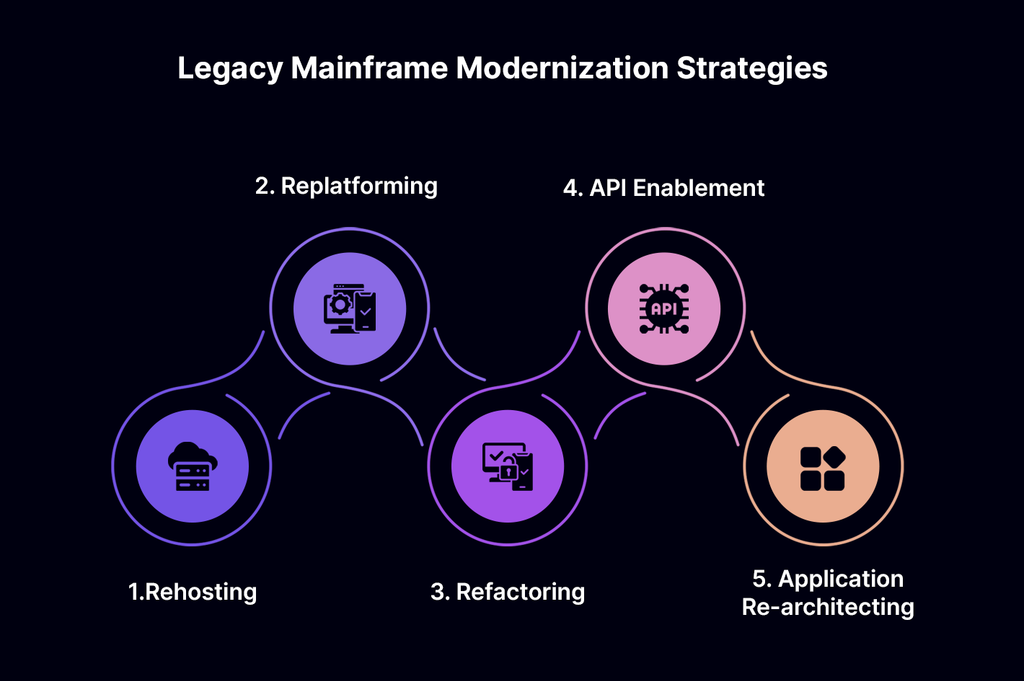
There isn’t a single path to Legacy Mainframe Modernization. The appropriate solution will depend on the business goals, complexity of the applications, regulatory considerations, integration requirements, and long-term technology goals.
In many cases, organizations focus on modernizing high-value business capabilities like payments, claims processing, customer onboarding, or inventory management instead of modernizing systems. This method provides tangible results with minimal risk of implementation.
With modernization becoming an ongoing business strategy, the right approach depends on the organization’s goals, application complexity, and tolerance for risk. Let’s explore the key legacy mainframe modernization strategies enterprises can adopt to determine the right path for each workload.
1. Rehosting
Rehosting, also known as “lift and shift,” involves transferring workloads to a new infrastructure while making minimal changes to the application.
This is often done to streamline infrastructure, enhance flexibility and operational agility, or when organisations wish to adapt to hybrid cloud environments without affecting their business processes.
Best suited for:
- Infrastructure optimization
- Data center consolidation
- Hybrid cloud adoption
- Faster infrastructure modernization
Business advantage:
Organisations can upgrade infrastructure without impacting on application behaviour or impacting on businesses.
2. Replatforming
Replatforming is a technique of adding enhancements to the application’s runtime environment, without redesigning the entire application.
This approach enables groups to implement new databases, middleware, development tools, or deployment platforms without impacting the basic business applications.
Best suited for:
- Improving application performance
- Simplifying operations
- Assisting with modern development environments.
- Enhancing scalability
Business advantage:
Organizations benefit from flexibility in their operations without having to redesign their application.
3. Refactoring
Refactoring emphasizes the structure of the application with the goal to retain the business function.
Applications can be made easier to enhance as time goes on and application services are modularized, code is reorganized, and dependencies are simplified to form manageable development teams.
A lot of companies are tying together refactoring, API enablement, and DevOps practices to enable continuous software delivery.
Best suited for:
- Long-term modernization initiatives
- Continuous product development
- API-driven architectures
- Agile engineering teams
Business advantage:
It is easier to maintain, integrate and evolve the application as business needs evolve.
4. API Enablement
Today’s enterprise applications are part of an interconnected ecosystem. APIs enable that.
In addition, organizations make a subset of their business services available as secure, reusable services that can be accessed by other cloud applications, mobile apps, customer portals, analytics platforms and partner systems, rather than replace their existing applications.
API enablement provides a way to leverage business processes that have already been established and work within the current business processes without interrupting core business operations.
Business advantage:
Organizations leverage existing applications and fasten enterprise-wide integration.
5. Application Re-architecting
There are some business applications that change quite a bit over time. In such situations, organizations rearchitect segments of the application as modular or services-based architectures but maintain the functional areas that remain valuable to the business.
Teams don’t rebuild everything, but they modernize those areas that have the greatest business impact.
Best suited for:
- Complex enterprise applications
- Digital transformation initiatives
- Long-term modernization programs
Business advantage:
Organizations enhance flexibility and decrease the complexity of future improvements.
How to Choose the Right Modernization Strategy
Successful Legacy Mainframe Modernization begins with business priorities not technology preferences.
Before selecting a modernization approach, enterprise leaders typically evaluate:
- Business criticality
- Application complexity
- Integration requirements
- Regulatory obligations
- Performance expectations
- Technical dependencies
- Available skills
- Long-term modernization goals
There are a number of organizations which choose to use a mix of strategies instead of one. APIs might be part of the same modernization as customer-facing services, internal applications might be refactored, and supporting workloads might be rehosted as part of the same modernization program.
The objective is to create a roadmap that delivers measurable business value while supporting future innovation.
A Practical Roadmap for Legacy Mainframe Modernization
Roadmap for Legacy Mainframe Modernization
Step 1: Assess the Existing Environment
Step 2: Prioritize High-Value Business Capabilities
Step 3: Build an Integration-First Architecture
Step 4: Modernize Development Practices
Step 5: Embed Continuous Testing
Step 6: Measure and Optimize
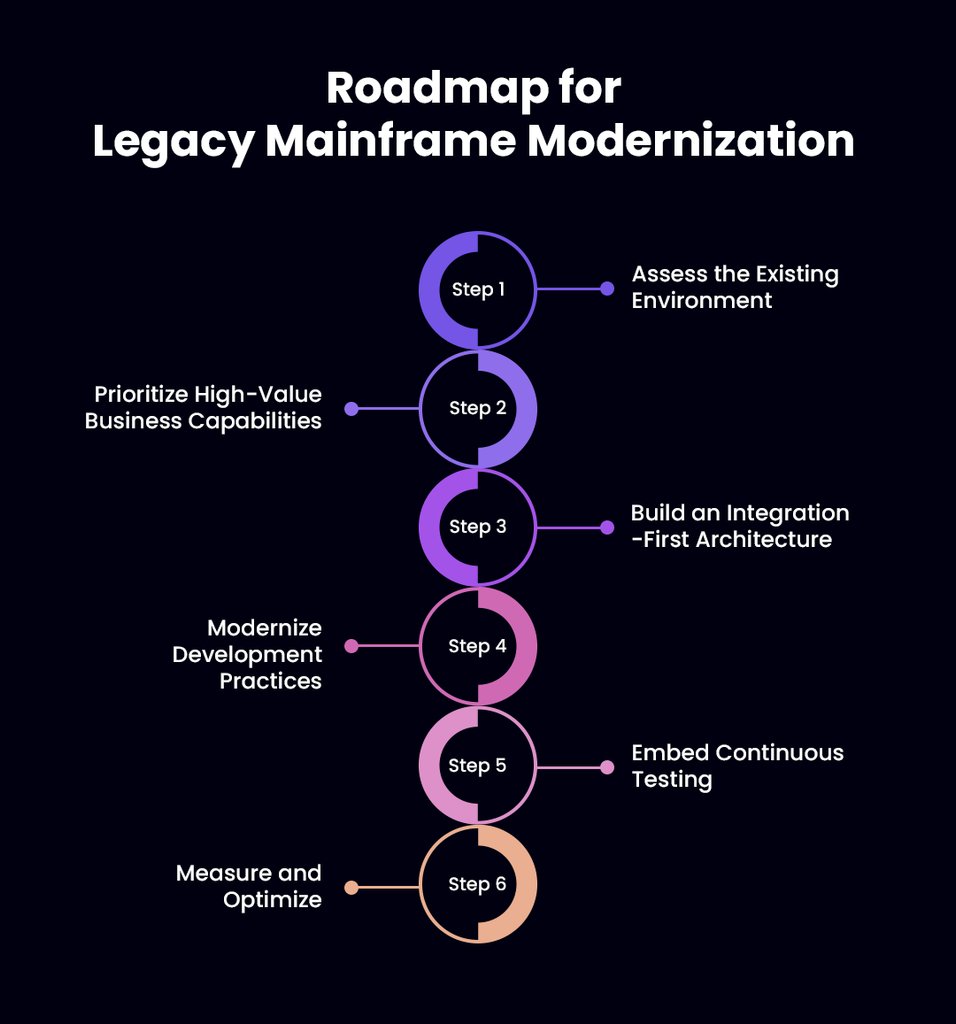
Modernization is most successful when it follows a structured, incremental approach. Instead of a one-shot modernization, organizations move through phases, gaining validation at each one.
Step 1: Assess the Existing Environment
Start with understanding the existing situation.
Identify:
- Core business applications
- System dependencies
- Transaction flows
- Data integrations
- Technology stack
- Performance baselines
- Compliance requirements
A comprehensive assessment allows to focus on the business impact-based modernization efforts instead of technical assumptions.
Step 2: Prioritize High-Value Business Capabilities
Don’t try to update applications but invest in services that deliver significant results.
Examples include:
- Digital payments
- Customer onboarding
- Claims processing
- Loan management
- Inventory management
- Policy administration
This step-by-step approach helps deliver value faster and makes the process of implementation easier.
Step 3: Build an Integration-First Architecture
Today’s businesses rely on interconnected systems.
API gateways, event streaming, enterprise messaging, and integration platforms allow for secure connections to mainframe, cloud applications, enterprise software, and partner ecosystems.
The concept of an integrated system becomes the basis for the ongoing modernization process.
Step 4: Modernize Development Practices
Technology modernization succeeds when engineering practices evolve alongside applications.
Leading organizations adopt:
- Git-based version control
- CI/CD pipelines
- Infrastructure as Code
- Automated builds
- AI-assisted development
- Collaborative engineering workflows
These practices help to speed up delivery and provide uniform development experiences between teams.
Step 5: Embed Continuous Testing
Modern applications rarely operate independently.
Changes to one service can impact API’s, databases, middleware, web applications, and downstream processes. These interactions are continually tested throughout the software delivery lifecycle.
Organizations increasingly combine:
- Functional testing
- API testing
- Regression testing
- Integration testing
- End-to-end transaction validation
This can help to build confidence in releases and improve software delivery time.
Step 6: Measure and Optimize
Modernization doesn’t end after deployment.
Organizations should continuously monitor:
- Application performance
- Transaction success rates
- Deployment frequency
- Release quality
- Infrastructure utilization
- Customer experience metrics
This information enables teams to make the best use of applications and determine future modernization investments.
How AI Is Accelerating Legacy Mainframe Modernization
Artificial intelligence is emerging as a key enabler for modernization programs as opposed to replacing engineers; rather, it enables them to work more efficiently.
Organizations are applying AI to:
Application Understanding
AI can review extensive codebases, provide explanations for intricate business logic, uncover dependencies, and enhance documentation of applications.
Impact Analysis
Development teams have the ability to see the impact of updates on other applications, APIs, databases, and enterprise workflows before making changes.
Documentation Generation
AI streamlines manual tasks by creating technical documentation, code summaries, and modernization of insights to support knowledge transfer.
Development Productivity
AI-powered coding tools streamline the development process for enterprise applications, enabling teams to concentrate on more valuable engineering responsibilities.
Rather than replacing modernization strategies, AI enhances planning, execution, and ongoing application management.
Best practices for successful legacy mainframe modernization
Every modernization journey is unique, but the most successful initiatives share a common set of principles. Rather than focusing only on technology, organizations align modernization efforts with business priorities, engineering practices, and long-term operational goals.
Start with Business Value
The best way to modernize is to start with business capabilities rather than applications.
Focus on programs that enhance customer service, speed up services, streamline operations, or support strategic growth. This enables organisations to show tangible results early on, and to build momentum for future modernisation.
Modernize Incrementally
Large transformation programs don’t have to happen all at once.
Many businesses upgrade one capability, application, or business process at a time. Incremental modernization reduces complexity, improves planning, and allows teams to validate outcomes before expanding additional workloads.
Build Around APIs
APIs have become the foundation of modern enterprise architecture.
By exposing business services via secure APIs, mainframe applications can communicate with cloud platforms, mobile applications, analytics tools, partner ecosystems, and new AI services without altering the tried-and-true business logic.
Adopt Modern Engineering Practices
Modernization of technology is best accomplished when development practices follow suit.
Organizations are becoming more embracing:
- Git-based version control
- CI/CD pipelines
- Infrastructure as Code (IaC)
- Automated deployments
- AI-assisted development
- Collaborative engineering workflows
These practices enhance software quality, efficiency in software development, and consistency in software release.
Make Quality Assurance Continuous
Testing should evolve with modernization.
With increasingly connected applications, user journeys, APIs, databases, middleware, and downstream systems must be validated for each release.
Continuous quality assurance helps to give organizations confidence in the software releases, and helps them deliver software faster.
Measure Outcomes, Not Activities
Modernization is a long-term business strategy.
Organizations that are successful do not talk about how many applications have been migrated or how many servers have been replaced, but instead talk about things like how often applications are deployed, how available applications are, how the customers are using the application, how efficiently it is integrated, how productive the developer is, etc.
These metrics provide a clearer view of modernization success.
Industries Driving Legacy Mainframe Modernization
Mainframe modernization looks different across industries depending on business needs, regulatory requirements, and technology challenges. Let’s explore how leading industries are approaching their modernization initiatives.
Banking and Financial Services
Banks and financial institutions are embarking on the modernization of core banking applications through refactoring of monolithic applications, exposing mainframe functionality via APIs, modernizing databases and enabling integration with cloud-native applications. Some organizations adopt incremental modernization, keeping critical transaction processing on the mainframe while moving selected capabilities to distributed or cloud environments. With these initiatives, they provide the ability to deliver real-time digital banking experiences, rapid product development, integration with fintech platforms, and scalability without compromising transaction reliability and regulatory controls, crucial for financial services.
Insurance
Insurers are updating policy administration, claims, billing and customer-service applications that are based on legacy code and data that may span many years. Examples of modernization efforts include application restructuring into modular services, exposing legacy services via APIs, migrating specific workloads, and automated code analysis and testing. This enables insurers to link internal systems with digital customer platforms, speed up claims and policy processing, launch new products faster, and minimise the resources needed to support legacy applications.
Healthcare
Healthcare organizations are modernizing legacy applications to create more connected environments across patient administration, claims, billing, clinical systems, and healthcare data platforms. Application refactoring, API enablement, database modernization, cloud integration, automated data migration and testing are just some of the many initiatives that can be included. The modernization of these systems can help healthcare providers to enhance interoperability, ensure data is accessible across different applications, optimize administrative processes, and build a more robust platform for analytics and AI applications, all while maintaining data privacy, security, and compliance standards.
Government and Public Services
Government agencies are taking a phased approach to modernizing tax, benefits, licensing, citizen-service, and public-administration systems. Instead of replacing all critical systems at once, agencies can focus on high-value workloads, deploy APIs and digital interfaces, upgrade databases, and slowly migrate appropriate workloads to the cloud and hybrid environments. Automation and AI-powered code analysis can also be used to uncover dependency, to document decades-old business logic, and even to automate tests in advance of changes. This enables faster provision of digital services, better information sharing between departments, quicker response to policy changes, and a lower operational cost of using legacy infrastructure.
Telecommunications
Telecommunications companies are modernizing legacy billing, customer management, provisioning, and network-support systems to support 5G, digital services, real-time customer interactions, and increasingly complex network environments. The modernization efforts can be as varied as the software itself, including decomposing monolithic applications, making core capabilities available via API, shifting some workloads to the cloud and automating operations. This allows telcos to scale services more effectively, speed up the roll-out of new services, enhance real-time billing, customer experience, and more seamlessly connect legacy systems with modern networks and cloud-based technologies.
Measuring the Success of Legacy Mainframe Modernization
Now, let’s look at how enterprises can measure whether their modernization efforts are delivering the expected technical, operational, and business outcomes.
Financial Metrics
- Total Cost of Ownership (TCO): Analyze infrastructure, licensing, maintenance and operating expenses before and after modernization.
- Return on Investment (ROI): Measure the financial returns generated against the investment required for modernization.
- Operating Costs: Monitor infrastructure, maintenance, and support cost changes.
Operational & Performance Metrics
- System Availability: Modernized environments should be as reliable and have comparable uptime as the legacy system.
- Application Performance: Measure transaction processing rates, response times and system capacity.
- Security & Compliance: Monitor, track vulnerabilities, security incidents, findings, and compliance improvements.
Modernization Quality Metrics
- Functional Equivalence: Test to determine if modernized applications provide the same business behaviour and outputs as the legacy system.
- Test Coverage: Automated test for important business functions.
- Defect Rates: Monitor defects found during testing and after deployment to production.
- Data Integrity: Ensure data is accurate, complete, accurate, complete and consistent across the migration.
Business Agility Metrics
- Time to Market: Evaluate how fast teams can develop and deploy new features, services, and integrations.
- Deployment Frequency: Monitor how often teams can safely deploy application changes.
- Lead Time for Changes: Track the time required to get changes from development to production.
- Business Flexibility: Assess the ability of the updated area(s) to meet evolving demands.
Developer & Talent Metrics
- Developer Productivity: Measure improvements in development and maintenance efficiency. Maintenance Effort: Track reductions in manual maintenance and legacy-system dependencies.
- Skill Dependency: Measure if modernization decreases dependence on valuable legacy technology skills.
- Automation Adoption: Quantify the adoption of automated testing, CI/CD, code analysis and documentation.
Business Impact
- Customer Experience: Assess digital service improvements and interactions with customers.
- Innovation Velocity: Measure the organization’s ability to bring new products, services and integrations to market.
- Revenue Impact: Consider any new revenue opportunities that may be available as a result of modernization or any loss or protection of existing revenue streams.
- Business Value: Ensure that the modernized environment is bringing the right results as per the strategic goals set at the outset of the initiative.
Legacy Mainframe Modernization Checklist
Use this checklist to assess your readiness for a successful legacy mainframe modernization:
1. Assess Your Existing Environment
- Manage COBOL, PL/I, Assembler, JCL, databases, and integrations.
- Map application dependencies and data flows.
- Determine critical business logic and undocumented business rules.
- Measure technical debt, application complexity, application performance.
- Evaluate internal expertise, tribal knowledge, and talent deficiencies.
2. Define Your Modernization Strategy
- Define clear business and technical modernization objectives.
- Choose the right approach: Rehost, Replatform, Refactor, Rearchitect, Rebuild, Replace, or Retain.
- Evaluate cloud, distributed, and hybrid infrastructure options.
- Compare costs, risks, timelines, and expected business value.
- Prioritize workloads based on business criticality and modernization readiness.
3. Understand and Preserve Business Logic
- Extract and document business rules embedded in legacy applications.
- Identify dependencies between programs, data, and processes.
- Validate business logic before modifying or translating code.
- Identify critical vs redundant/obsolete parts.
- Use AI and automation to accelerate code analysis and knowledge discovery.
4. Build a Comprehensive Testing Strategy
- Develop a baseline for current system behavior.
- Automate functional and regression testing.
- Test critical business rules, edge cases, integrations, and data transformations.
- Compare legacy and modernized system outputs for behavioral equivalence.
- Use parallel testing or phased validation before production cutover.
5. Execute the Migration Securely
- Migrate workloads in manageable phases.
- Establish data migration and synchronization processes.
- Protect applications, APIs, databases, and sensitive data throughout migration.
- Define rollback and disaster recovery procedures.
- Set clear validation and go/no-go criteria for each migration phase.
6. Optimize After Modernization
- Check and track performance, availability, latency, and error rates.
- Validate that modernized applications meet business requirements.
- Maximize infrastructure and operating expenses.
- Implement CI/CD and automated tests pipelines.
- Continually enhance application performance, documentation, and maintainability.
Conclusion
Today, mainframes still have a strong presence in enterprise technology, powering the mission-critical applications and business processes that organizations need every day.
Legacy Mainframe Modernization’s efforts in 2027 will continue this value by integrating the legacy system with modern systems and technologies, improving engineering with AI, connecting to the cloud, adopting DevOps principles, and fostering ongoing innovation. Instead of replacing systems that are still performing very well, businesses are developing these systems for use in technology ecosystems that connect with the future.
The organizations driving the modernization effort aren’t just using new technologies—they’re establishing an environment in which applications can continue to morph, engineering teams can produce software more efficiently, and business services are more resilient to shifting expectations and technology.
In the modernizing world of enterprise, software quality is as crucial as modernizing the software. By embedding continuous testing and end-to-end QA in the modernization lifecycle, organizations can rely on continuous improvements with confidence without compromising the reliability mission-critical systems require.
FAQ
No. Legacy Mainframe Modernization includes a broad range of strategies such as API enablement, application refactoring, DevOps adoption, infrastructure optimization, AI-assisted development, and continuous quality assurance. Migration may be one component of a modernization strategy, but it is not the only approach.
Yes. Many businesses leverage existing mainframe applications with added capabilities via cloud-based applications, new development tools, APIs, and automation, while maintaining the proven, business-level functionality.
The timeline depends on the complexity of the application, modernization objectives, business requirements, and strategy of implementation. Many organizations take a stepwise approach and provide value in stages instead of a massive single project of modernization.
AI assists teams by analyzing codebases, generating documentation, identifying dependencies, supporting impact analysis, and improving developer productivity. It complements modernization efforts by simplifying planning and accelerating engineering workflows.