

Blog

The Complete Guide to AI-Powered Mainframe Testing in 2027

Table of Contents
What is Mainframe Testing?
What Is AI-Powered Mainframe Testing?
How Does Mainframe Testing Work?
Types of Mainframe Testing
Why AI-Powered Mainframe Testing Matters?
The Six Layers of AI-Powered Mainframe Testing
What Makes AI-Powered Mainframe Testing Genuinely “AI-Powered” (vs. Just Automated)
Traditional vs. AI-Powered Mainframe Testing
Best Practices for AI-Powered Mainframe Testing
How Zyrix Test Autopilot Delivers Human-in-the-Loop, AI-Powered Mainframe Testing
How to Get Started with AI-Powered Mainframe Testing
Final Thoughts on AI-Powered Mainframe Testing
Frequently Asked Questions (FAQs)
Introduction
Whenever anyone taps a card at a checkout counter or withdraws cash from an ATM, there’s a very good chance that a COBOL program running on a mainframe is processing that transaction. The silent reality of enterprise IT in 2027 is that while many organizations are pursuing digital transformation and enterprise modernization, the systems powering critical business operations aren’t disappearing anytime soon. As these mission-critical systems continue to evolve, AI powered mainframe testing is becoming an essential part of ensuring application quality, accelerating validation, and reducing risk without disrupting core business operations.
What has changed is the pressure around them. Compliance requirements continue to grow more stringent, while experienced engineers who understand these legacy applications are retiring faster than they can be replaced. At the same time, business leaders who have seen web and mobile teams deliver weekly releases are asking why mainframe systems cannot achieve the same agility. As a result, legacy application testing has become a critical priority for organizations looking to modernize without compromising stability or reliability.
The old answer to “How are we going to test the mainframe faster?” was to hire more specialists or accept slower release cycles. Neither approach scales in 2027. That’s where AI software mainframe testing comes in, shifting organizations away from manually written and constantly breaking test suites toward self-generating, self-running, and self-healing AI-driven testing platforms. This guide explains what AI testing for mainframes is, how it supports the modern mainframe testing lifecycle, and how platforms like Zyrix Test Autopilot help enterprises accelerate enterprise modernization while maintaining the reliability of their mission-critical systems.
What is Mainframe Testing?
Mainframe testing is the process of verifying applications, programs, transactions, batch jobs, databases, and integrations on or with mainframe systems.
Unlike testing a standalone web or mobile application, mainframe testing can be more complex with a distributed application that involves complex business logic across technologies like COBOL, PL/I, JCL, CICS, IMS, Db2, VSAM and 3270 terminal interfaces.
In addition to the ability to determine if individual programs execute correctly, testing needs to ensure that entire business processes remain intact when systems are integrated.
For instance, a banking transaction could start on a mobile app, hit an app, trigger processing on a mainframe, update an Db2 database, and return a result back to the customer.
If any component fails, it can impact the whole transaction. So, end-to-end validation is critical to today’s modern mainframe Quality Assurance.
What is AI-Powered Mainframe Testing?
AI-powered mainframe testing leverages artificial intelligence (AI) technologies like machine learning, natural language processing, and agentic AI to enhance the process of mainframe testing.
AI supported testing platforms can support teams to help build and manage a vast number of scripts without the need for engineers to do this manually.
Create test scenarios based on requirements and business processes
Generate tests with natural language instructions
Recognize areas of non-coverage in the test set.
Take advantage of automation when application interfaces change,
Focus on testing that are high risk and application changes
Review and give insightful diagnosis for failures
Create test evidence and reports autonomously
The goal is not just to automate current manual testing, but to make mainframe testing smarter, more flexible, and easier to maintain.
How Does Mainframe Testing Work?
The lifecycle of Mainframe testing is structured and used to validate application, functionality, business logic, integration, and system performance.
1. Requirements Analysis
QA teams analyze business requirements, user stories, application changes, technical documentation, to understand what they have to validate.
AI can assist by analyzing requirements and identifying potential test scenarios and coverage areas.
2. Test Planning
Teams decide the scope of the tests, what is needed to test, what is dependent upon the tests, test data, and important business-critical workflows.
Risk-based analysis can be used to identify those areas with the greatest business impact where changes in application might have the most impact.
3. Test Environment Setup
Specific z/OS environments, data bases, terminal applications, batch systems, and enterprise platforms may be necessary for conducting mainframe testing.
Testing timelines are often affected by the conditions and requirements of the environment.
4. Test Data Preparation
QA team requires real data to test various business scenarios without revealing sensitive production data.
Safe and representative data can be developed using synthetic test data and test data management techniques.
5. Test Creation and Execution
Tests are created for individual programs, transactions, batch jobs, integration, and entire business process basis.
AI-driven platforms can be used to automatically create and run tests according to the requirements and application behavior.
6. Defect Analysis
Teams review logs, system behaviors, and dependencies when tests fail and identify the cause.
Using AI to assist with root cause analysis can help to identify possible failure points and lessen manual investigation.
7. Regression Testing
The current functionality is tested after application changes to assure that new changes have not impacted any critical business process.
AI can be used to prioritize regression tests with risk, application changes, and historical test results.
8. Reporting and Compliance
Test results, evidence, approvals, and audit trails are documented.
For regulated industries, automated evidence collection can improve traceability and compliance with readiness.
Types of Mainframe Testing?
Mainframe testing is typically broken down into multiple layers because these systems support complex business processes and interact with a wide range of enterprise applications and technologies. Here is the breakdown of each layer:
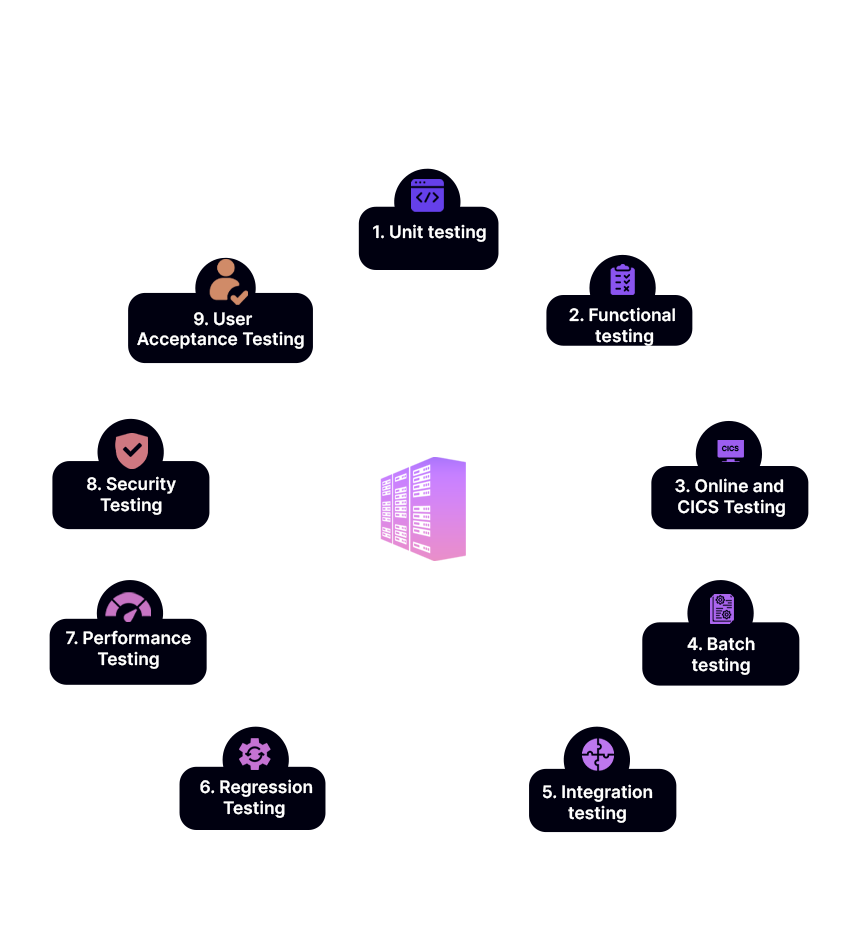
1. Unit Testing
Validates a single COBOL, PL/I or Assembler program at the module level. For instance, running a COBOL program that computes interest on a loan helps to detect logic errors early on, preventing them from impacting larger workflows.
2. Functional Testing
Ensures that applications on the mainframe run according to business requirements. For example, making sure a policy processing system properly calculates premiums according to the input parameters and business logic.
3. Online and CICS Testing
Checks real time transactions that are processed through systems like CICS and terminal-based interfaces. A typical test is to ensure that a banking transaction that appears on the 3270 screen is correctly reflected in account balances and that the change is reflected immediately.
4. Batch Testing
Monitors JCL jobs and large data processing operations. For instance, verifying that payroll processing operations are completed without any issues, accurate payroll is calculated, and employee information is maintained correctly.
5. Integration Testing
Verifies that applications running on the mainframe communicate properly with databases, APIs, middleware and external components. For example, to ensure that a retail point of sale system updates the central inventory in Db2 after every transaction.
6. Regression Testing
Must not have any code changes, fixes or enhancements that will break existing functionality. After each update, a set of important legacy processes need to be re-validated to ensure that the system remains stable.
7. Performance Testing
Measures the behavior of measures of the system under expected loads (transactions, response times, resources used etc.). For instance, making sure that insurance claim batch jobs run and do not degrade performance when they run.
8. Security Testing
Checks authentication, authorization, data protection and security policies. This guarantees the security of sensitive data, including financial or healthcare records, from unauthorized access.
9. User Acceptance Testing
Ensures that the whole business processes are finalized to satisfy the user’s and organization’s requirements before the deployment. This phase guarantees that the system is prepared for its use in the real world.
These layers together form the backbone of enterprise-grade validation. Without them, even small glitches can escalate into large-scale failures.
Why AI-Powered Mainframe Testing Matters in 2027
Mainframes are still heavily used in sectors where reliability, security, and transaction processing are paramount.
At the same time, QA teams face increasing pressure to deliver application changes faster without compromising system stability.
The following three considerations are driving the shift towards AI-driven mainframe testing.
Declining Mainframe Expertise
QAs who understand technologies like COBOL, JCL, z/OS and CICS are still relied upon by organizations.
With the retirement of experienced professionals, it can become more challenging to maintain large manually scripted test suites.
The ability to have AI-assisted and codeless testing can help lower reliance on specialized scripting knowledge, as well as enable seasoned professionals to concentrate on higher-value quality decisions.
Increasing Compliance Requirements
In sectors such as banking, financial services, insurance, government, and health, the requirements for organizations are strict in terms of both regulatory and operational aspects.
It is often necessary to prove a testing process that the entity had been tested, for how long, and that critical requirements had been validated through it.
Reporting and traceability can be aided by automation to enhance audit readiness.
Faster Release Expectations
In today’s web, mobile, API, and cloud teams, software is released more often than the traditional mainframe software release cycle.
Enterprises are linking their mainframe systems to today’s applications, and testing needs to be more agile to meet the dramatically shorter release schedules yet maintain the reliability of their core systems.
The Six Layers of AI-Powered Mainframe Testing
Most mainframe testing tool comparisons ignore this aspect, but it is the basis for understanding how AI testing mainframe improves. Mainframe testing isn’t one layer, it’s six, and each has a different mode.
1. COBOL / PL/I Unit Testing
AI-supported testing can aid in creating test scenarios, edge cases, and synthetic test data for individual programs.
This can help to save time and effort in developing unit level coverage.
2. 3270 Terminal / Green-Screen Automation
When screens or workflows change, especially in a traditional coordinate-based terminal automation, it can become hard to maintain.
AI-powered and codeless methods can enhance the resilience of terminal automation by understanding the context of the terminal and the business processes, rather than just relying on hardcoded scripts.
3. Batch Job (JCL) Testing
AI-powered batch testing can aid in validating:
- Processing correctness
- Job completion
- Data integrity
- Performance
- Failure and recovery behavior
This is especially useful for large batch processes, where the errors may have repercussions on downstream processes.
4. Integration and Cross-System Testing
Mainframes often communicate with APIs, cloud systems, SAP, Salesforce, ServiceNow and more.
By using unified test automation, it is possible to validate entire workflows through these technologies and not just individual applications.
5. Performance and Capacity Analysis
Unusual performance patterns can be detected by analyzing CPU usage, I/O activity, transaction response times, and workload behavior with the help of AI.
This can allow teams to identify issues that could impact performance prior to them becoming a problem in production systems.
6. Test Management and Compliance Reporting
AI Test Platforms can automatically record test results, execution history, evidence and traceability of information.
This not only helps to create a defensible record of the testing activities, but also limits the man-hours dedicated to manual reporting.
Combining these six layers is one of the most prevalent mistakes that enterprises make when selecting the mainframe testing tools that they purchase, a tool that might be good at terminal automation for them and not so good at batch validation, or the other way around. Full stack AI-powered mainframe testing platforms like zyrix are designed to address all six in one.
What Makes AI-Powered Mainframe Testing Genuinely “AI-Powered”
Not all AI Software testing are actually using AI. Let’s look at what a true AI-powered mainframe testing experience should entail:
1. Plain-language test creation.
Testers can formulate their test desires in regular english, and the AI converts it into a genuine test (no coding required).
2. Self-healing tests.
The tool detects and corrects the test when a screen or a field change without an error occurring.
3. AI that thinks ahead, not just plays back
Good AI doesn’t just duplicate test scripts, it identifies the missing from the testing and develops new tests on its own.
4. Smart prioritizing.
The AI instead knows which tests are important and performs those first, instead of running all of them each and every time.
5. Assist in solving problems.
When something fails, the AI points to the likely cause instead of leaving a person to dig through logs for hours.
6. Human-in-Loop
In important systems like banking, AI shouldn’t work completely on its own. People should review everything critical.
7. Coverage across everything
The ideal tools test the mainframe in concert with web, mobile, and other business applications not alone.
Traditional Mainframe Testing vs. AI-Powered Mainframe Testing
The table below summarizes the core differences between traditional mainframe testing and AI-powered mainframe testing, side by side:
| Dimensions | Traditional Mainframe Testing | AI-Powered Mainframe Testing |
|---|---|---|
| Test Creation | Manual scripting, requires COBOL/JCL/3270 expertise | Codeless, natural-language and requirement-driven generation |
| Maintenance | Scripts break on every screen or code change | Self-healing scripts adapt automatically |
| Coverage | Limited by tester bandwidth and time | Continuously expanded with AI-powered gap analysis |
| Failure diagnosis | Manual log tracing, hours per incident | AI-assisted root cause analysis with visual evidence |
| Prioritization | Often runs full regression regardless of risk | Risk-based prioritization tied to business impact |
| Cross-system testing | Siloed by platform (mainframe, web, API tested separately) | Unified validation across mainframe, web, mobile, API, SaaS |
| Dependency | High | Low |
| Compliance documentation | Manually compiled after testing | Generated as a byproduct of the testing process |
Best Practices for AI-Powered Mainframe Testing
As organizations pursue mainframe modernization, testing needs to adapt to both old and new applications. Adhering to these best practices will result in higher software quality, reduced risks of release and more robust Enterprise QA.
Adopt Continuous Testing
Do not wait for testing to be the last step, but instead make it an ongoing step in the development process. By incorporating shift-left testing to find defects at an early stage, and continuing to validate throughout delivery, teams can provide more reliable and timely releases.
Focus on End-to-End Validation
Complete business workflows need to be validated against mainframe, web application, APIs and cloud applications to be effective. This prevents the changes in one system to affect changes in another system.
Prioritize Business-Critical Scenarios
All tests are not equal. To minimize risk and boost release confidence, first prioritize high impact business changes.
Keep Humans in the Loop
While automation can help speed up execution, business-critical scenarios and compliance needs should be reviewed by experienced QA professionals before deployment.
Continuously Improve Your Testing Strategy
Review test results following each release to find coverage gaps, improve coverage, and make necessary adjustments in the testing process. For the ongoing process of your mainframe modernization to be successful, you must always strive to improve the quality of your mainframe systems.
How Zyrix Test Autopilot Delivers Human-in-the-Loop, AI-Powered Mainframe Testing?
Zyrix Test Autopilot is built to test mainframes, websites, mobile apps, and business software like SAP and Salesforce, all from one platform.
Mainly, Zyrix doesn’t let AI run completely on its own. Mainframe systems are too important and too risky for that. Instead, Zyrix uses a “human-in-the-loop” approach. AI does the repetitive, time-consuming work, while people review and approve the important decisions.
In practice, this will look like this:
AI automatically creates test coverage, but it is reviewed and approved by people.
- Tests are automatically re-run when screens change, and important business logic changes are reported to a human to review.
- Tests are connected to actual requirements, such as Jira tickets and user stories, thus reflecting the business needs.
- A dashboard shows likely problems and evidence, empowering people to make quick, informed decisions rather than relying on guesswork.
- Cross system testing ensures that the mainframe is working well with modern apps.
- People stay involved by design, particularly for business-critical endeavors.
The Result: less time spent fixing broken test scripts, less manual busy work, and more time for QA teams to focus on the decisions that actually need a human.
How to Get Started with AI-Powered Mainframe Testing
If your enterprise is considering a shift to AI-powered mainframe testing, consider a gradual approach to minimize risk and yet provide measurable benefits early:
1. Begin with a problem and not a vendor list.
Don’t just evaluate tools, but rather determine the real slowdown, terminal automation, COBOL unit testing, or batch validation of the six layers of AI-powered mainframe testing.
2. Pilot on a single high-friction workflow
Select a process that is proving value within your business process (for instance, a specific batch cycle or a terminal workflow that you have tested regularly over time) to demonstrate value before scaling up.
3. Connect requirements early
Business logic-driven test coverage from the get-go, with user stories and documentation fed into the AI test generation process.
4. Maintain the human in the loop checkpoint
For workloads such as financial, insurance and government, have human review of AI-generated tests cases before they become the system of record for compliance.
5. Go outwards first, then inwards
After the initial mainframe workflow is stable, cover more systems (SAP, Salesforce, APIs) instead of deeper in the mainframe covered testing real production incidents occur in that realm.
6. Monitor Maintenance Hours, Not Only Pass Rates
The most obvious indicator for the ROI of AI testing on the mainframe isn’t the number of tests, it’s the number of hours spent on broken scripts following each release.
Enterprises that follow this sequence typically see AI-powered mainframe testing pay for itself within the first one to two release cycles, primarily through reclaimed maintenance hours rather than headcount reduction.
Final Thoughts on AI-Powered Mainframe Testing
Although the mainframe is not going away in 2027, the traditional mode of testing it over the years, using a manual, script-driven approach, is losing its momentum. Neither is it enough to speed up the old mainframe QA model: a new operating model for mainframe QA is needed one that leverages artificial intelligence (AI) to take the industry forward.
That operating model is AI-powered mainframe testing, with codeless test generation, agentic AI to discover coverage gaps, self-healing automation, and a unified validation process for mainframe and modern systems. A suite such as Zyrix Test Autopilot is designed to provide this: all-in-one, AI-powered testing as a single component on a continuum of an integrated enterprise stack, rather than the legacy mainframe as an island of isolation.
Ready to pilot step one?
Start a free trial with Zyrix and run your first AI-generated test suite against a real mainframe workflow this week.
Frequently Asked Questions (FAQs)
AI-powered mainframe testing is a technology that leverages AI, machine learning, and agentic AI to automatically create, run, manage, and fine-tune test cases for mainframe applications. It eliminates manual scripting by means of natural language test creation, self-healing automation, intelligent test prioritization, and AI-driven root cause analysis, among other features, unlike traditional testing.
Traditional mainframe testing is manual with a lot of scripting, record and playback, and lots of maintenance when the application changes. AI-driven mainframe testing automatically creates tests, adjusts UI or application changes, detects the lack of test coverage and offers quicker diagnostics, thereby cutting down maintenance effort and increasing the accuracy of testing.
Yes. Today, COBOL program testing, JCL batch validation, 3270 terminal automation, integration testing, and regression testing can be automated using the modern AI-powered testing platforms. AI can also suggest more test coverage based on the application behaviour, generate relevant test scenarios and create synthetic data.
Organizations commonly face:
High manual scripting effort
Shortage of COBOL and z/OS specialists
Frequent script failures after application changes
Slow regression cycles
Limited end-to-end testing across enterprise systems
Time-consuming compliance documentation
Difficulty keeping pace with modern release cycles
AI-powered testing helps overcome these challenges by eliminating repetitive tasks and retaining human involvement in crucial decision-making processes.
AI-driven mainframe testing is especially beneficial for organizations with critical legacy applications, such as:
Banking and Financial Services
Insurance Government agencies
Healthcare
Telecommunications
Retail
Transportation
Manufacturing
The industries they serve are high reliability, fast release, and strict compliance.
Here are some benefits AI-powered mainframe testing can offer:
Faster release cycles
Reduce testing maintenance costs
Improved regression coverage
Reduced production defects
Better compliance readiness
Increased tester productivity
Improved root cause identification
Higher confidence in mission-critical releases
These benefits enable enterprises to modernize legacy testing and continue to deliver the reliability of mainframe systems.