


Blog

Why Enterprise AI Projects Stall Before Production and the Quality Gates That Fix It
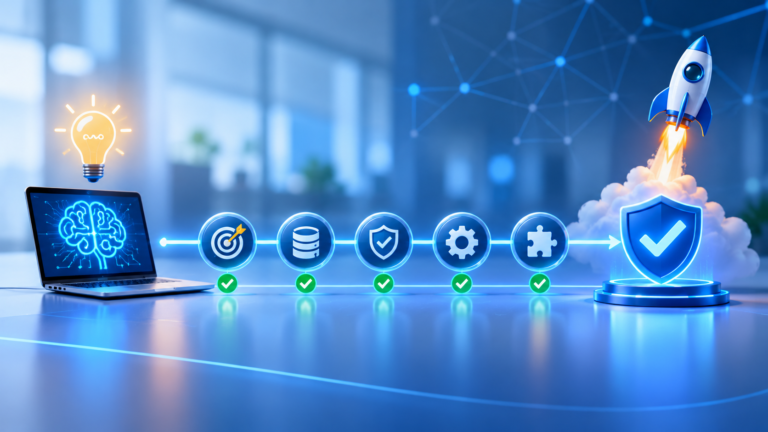
Most enterprise AI projects that stall between prototype and production do so for the same reason: nobody defined, in measurable terms, what “ready for production” means. The prototype proves the idea can work. Moving from AI prototype to production requires proof that it works reliably, safely, and affordably on real data, for real users, inside real systems. Quality gates provide that proof in stages, so problems surface early instead of at launch.
Key Takeaways
- AI pilots rarely fail because the model is weak. They stall on undefined success criteria, unready data, demo-level testing, late compliance reviews, integration and cost surprises, and no plan for life after launch.
- A quality gate is a checkpoint with clear exit criteria. A project moves forward only when it meets them.
- Six gates cover the path from prototype to production: business case, data readiness, functional validation, robustness and safety, integration and operations, and the go/no-go decision.
- Set the exit criteria before the pilot starts, not after the demo.
How Many Enterprise AI Projects Stall?
Research from several firms points the same way:
- In its State of AI 2025 survey of 1,993 respondents, McKinsey found that nearly two-thirds of organizations have not yet begun scaling AI across the enterprise.
- Gartner predicted that at least 30% of generative AI projects would be abandoned after proof of concept by the end of 2025, because of poor data quality, inadequate risk controls, escalating costs, or unclear business value.
- Gartner also predicts that over 40% of agentic AI projects will be canceled by the end of 2027, and that organizations will abandon 60% of AI projects that lack AI-ready data through 2026.
Notice that every reason Gartner names (data, risk, cost, value) is something a team can check before launch.
Prototype vs. Production: What Changes
A prototype and a production system answer different questions. The prototype asks “can this work?” Production asks “will this work every day, for everyone, without causing harm?”
| AI prototype | Production AI | |
| Data | A clean sample or export | Live, messy, changing data from many systems |
| Users | A few friendly testers | Hundreds or thousands of real users |
| Testing | A handful of example prompts | Hundreds of representative cases, run repeatedly |
| Success | “The demo looked good” | Measured against agreed targets |
| Risk and compliance | Out of scope | Security, privacy, legal, and audit sign-off |
| Cost | Small, often ignored | Cost per transaction tracked against budget |
| After launch | Nothing | Monitoring, alerts, and re-validation |
6 Reasons Enterprise AI Projects Stall Before Production
1. No measurable definition of success
The pilot was approved to “explore” or “prove value”, so nobody agreed what number would justify production. When the demo ends, the debate begins, and the project waits.
2. Data that worked in the pilot but not in reality
Pilots often run on a curated export. Production needs live access to scattered, inconsistent, and permission-controlled data, and that work was never planned.
3. Demo-level testing
The team tried a few dozen prompts and the answers looked right. Nobody knows how the system behaves across hundreds of real cases, unusual inputs, or repeated runs, so nobody can sign off on it with confidence.
4. Risk and compliance arrive at the end
Security, privacy, legal, and model-risk reviews start only when launch is near. They raise questions the team cannot answer with evidence, and the project goes back several steps.
5. Integration and cost surprises at scale
The prototype ran standalone. In production it must connect to identity systems, business applications, and logging, and its cost per request suddenly matters when multiplied by thousands of daily users.
6. No owner and no plan for life after launch
There is no named business owner, no monitoring, and no plan for what happens when quality drifts. Leadership is reluctant to approve a system nobody will run.
6 Quality Gates from AI Prototype to Production
A quality gate is a checkpoint with clear exit criteria. The project moves to the next stage only when it meets them, and each gate produces evidence that later reviewers (security, legal, leadership) can rely on. Together, the gates turn “is it ready?” from an opinion into an AI production readiness decision backed by data.
| Gate | Fixes this stall | Exit criteria | Example threshold |
| 1. Business case and success criteria | No definition of success; no owner | Named business owner, measured baseline, agreed targets, risk level assigned | Target set: reduce handling time from 25 to 10 minutes per case |
| 2. Data readiness | Data that only worked in the pilot | Production data sources, access approved, quality checks passing, privacy handling agreed | 98% of documents processed correctly; personal data masked |
| 3. Functional validation | Demo-level testing | Tested on a representative, labelled set of real cases; results meet targets | 95% or more of answers correct on 300 real cases |
| 4. Robustness, safety, and compliance | Late risk and compliance reviews | Edge cases, adversarial inputs, repeated runs, bias checks where relevant; security and legal sign-off | 0 critical errors; consistent results across 3 runs |
| 5. Integration and operations | Integration and cost surprises | Connected to real systems; speed, cost, load, access control, and fallback tested | Response under 5 seconds; cost per case within budget |
| 6. Go/no-go and production readiness | No plan for after launch | Evidence reviewed; monitoring, alerts, rollback plan, and owner in place | Formal go decision with re-validation scheduled |
Thresholds are illustrative. Set your own for each use case and its level of risk.
What AI validation means at gates 3 and 4
AI validation is the process of checking, with evidence, that an AI system produces correct, safe, and consistent results for its intended use. At gate 3, that means testing against real cases with known correct answers. At gate 4, it means pushing the system with what a pilot never sees: incomplete requests, contradictory documents, manipulation attempts, and the same question asked several times. Because AI outputs can vary between runs, a result that passes once is not enough; it has to pass consistently.
Example: A Claims-Summary Assistant Through the Gates
This is an illustrative example.
An insurer builds an AI assistant that reads claim files and policy documents and drafts a summary for adjusters. The demo impresses leadership. Here is how the gates turn that demo into a production decision:
- Business case: The claims director becomes the owner. Today a summary takes about 25 minutes; the target is under 10 minutes with no drop in accuracy.
- Data readiness: The team discovers that 15% of older claim files are scanned images the pilot never saw. They add document processing and a quality check before moving on.
- Functional validation: On 300 real past claims with known correct summaries, the assistant scores 91%, below the 95% target. Most errors involve policy exclusions, so the team improves how exclusions are retrieved and re-tests to 96%.
- Robustness and safety: Testers feed in contradictory documents and a claim note containing hidden instructions. The assistant follows the hidden instruction once in three runs. The team adds input filtering, re-runs the suite, and records zero failures. Legal and security sign off using the test evidence.
- Integration and operations: Connected to the claims system, responses take 9 seconds at peak, above the 5-second target, so the team adds caching and a smaller model for simple claims.
- Go/no-go: With evidence from every gate, the review takes one meeting. The assistant launches to one region with monitoring, a weekly accuracy sample, and a rollback plan, then expands.
Without the gates, each of these problems would most likely have surfaced after launch, in front of adjusters and customers.
How Zyrix AI Helps
Zyrix AI helps enterprises build AI products with quality gates built in. Its AI Product Engineering service takes projects from scoping and prototype through hardening and deployment, and ATLAS, its AI agent testing platform, produces an evidence-backed production readiness score and a go/no-go recommendation before each release. For agent-specific guidance, see how to test AI agents.
Stuck Between Pilot and Production? Talk to our engineers about the gates your AI project needs to clear. [Discuss Your AI Product]
Frequently Asked Questions
Why do AI projects stall between prototype and production?
Most stall because “production-ready” was never defined in measurable terms. Common causes are unclear success criteria, data that is not production-ready, testing limited to demos, late security and compliance reviews, integration and cost surprises, and no owner or monitoring plan for after launch.
How do you move AI from prototype to production?
Define success criteria and an owner before the pilot, then pass the project through quality gates: data readiness, functional validation on real cases, robustness and safety testing, integration and operations testing, and a formal go/no-go review with monitoring in place.
What is AI production readiness?
AI production readiness means an AI system has evidence that it meets agreed targets for accuracy, safety, consistency, speed, and cost on real data, is integrated with the systems it depends on, and has an owner, monitoring, and a rollback plan.
What is AI validation?
AI validation is the process of checking, with evidence, that an AI system produces correct, safe, and consistent results for its intended use. It typically includes testing on representative real cases, edge cases, adversarial inputs, and repeated runs.
What are quality gates in AI development?
Quality gates are checkpoints with clear exit criteria that an AI project must meet before moving to the next stage. They catch problems early and give security, legal, and leadership reviewers the evidence they need to approve a launch.
How long does it take to move an AI prototype to production?
It depends on data readiness, integration complexity, and risk level. Projects that define success criteria and quality gates before the pilot usually move faster, because reviews rely on evidence gathered along the way instead of starting from scratch at the end.