

Blog

Why LLM-as-a-Judge Is Not Enough for AI Agent Testing

Introduction
LLM-as-a-Judge is not enough for AI agent testing because it evaluates what an agent says, while agents also need to be tested on what they do. An agent can produce a correct-looking response while choosing the wrong tool, using incorrect arguments, skipping a required step, or failing to recover an error. This is why agent testing must evaluate the full execution path, not just the final response.
By 2026, enterprise adoption of multi-step AI agents grew by over 300%, driving a shift from simple chat interfaces to complex, tool-using autonomous workflows. AI agents plan, call tools, read databases, write them, and retry when something fails, sometimes without exposing those failures in the final response.
This is the gap LLM-as-a-Judge wasn’t built to close. This guide looks at where LLM-as-a-Judge holds up, where it falls short for agentic systems, and what a testing framework needs to evaluate when the system being tested is a sequence of decisions and actions, not just a response.
What Is LLM-as-a-Judge?
LLM-as-a-Judge is an evaluation method in which a powerful large language model is used to score, classify, or critique the text outputs produced by another AI application or model. The judge receives the relevant input, one or more candidate responses, and an evaluation of instruction or rubric.
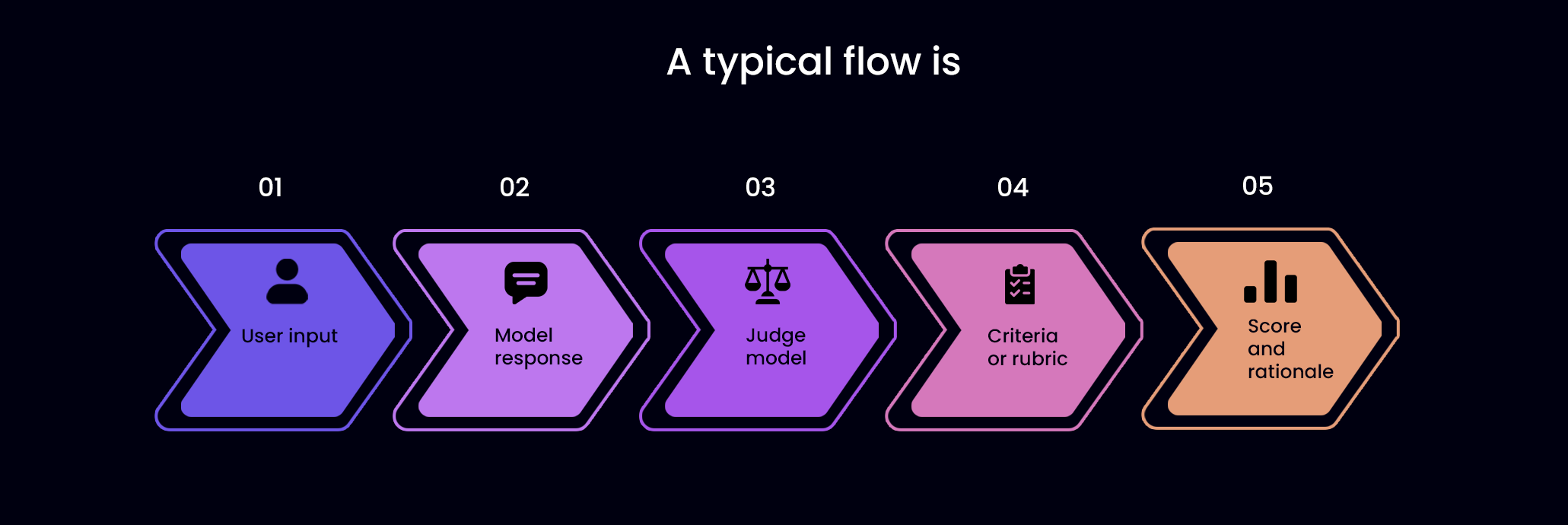
The approach is valuable because language quality is often semantic. A response can be worded ten different ways and still be correct, so judging it against rigid keyword or reference matching would flag good answers as failures.
An LLM judge can evaluate that kind of semantic correctness the way a human reviewer would, at a scale no human team can sustain. It scores large test sets consistently, explains its reasoning for triage, and surfaces regressions before anyone must review outputs by hand.
LLM-as-a-Judge is strong at evaluating what a response says, but it has no visibility into what the agent did to produce that response. That’s the boundary: judging language versus judging action, and it’s worth seeing where exactly it falls.
What Is AI Agent Testing?
AI agent testing is the practice of evaluating an agent as a complete system carrying out a task, not just checking the output it sends back at the end. Where a chatbot only needs to be judged on what it says, an agent needs to be judged on what it does to get there.
That makes the scope of testing wider because there are more ways for an agent to fail. It must understand the user’s intent, identify missing information, form a plan, select the right tools and arguments, maintain context across steps, interpret tool responses, recover from failures, and complete the task within its authorization. AI agent testing helps identify failures across this entire process, not just in the final response.
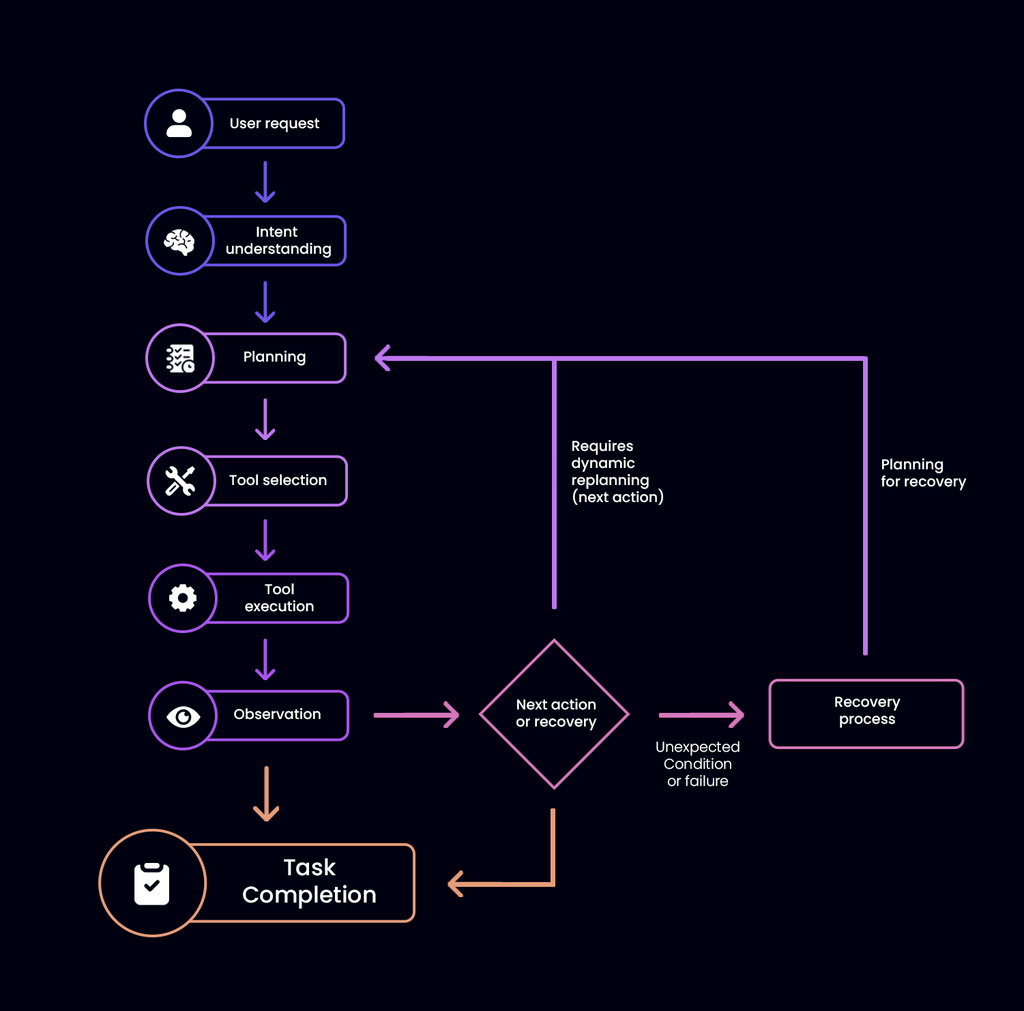
This is exactly why that distinction matters in practice: a final answer is only one observation of the system, not a complete record of what it did to produce that answer. A response can read perfectly fluently while, underneath, the agent used stale context, called an API twice, skipped an authorization check, or claimed success after a transaction actually failed. None of that shows up in the words themselves.
Research on trajectory-aware evaluation backs up. TRAJECT-Bench, for instance, does not just score final accuracy. It also checks tool selection, whether the arguments passed to each tool were correct, and whether steps happened in the right order with the right dependencies satisfied. Its authors document failure modes, such as an agent confusing two similar-looking tools or choosing a tool without checking whether its parameters fit the situation, that a final-answer metric would miss entirely.
LLM Evaluation vs. AI Agent Testing
LLM evaluation and AI agent testing ask for different evidence. LLM evaluation works from a prompt and a final response. AI agent testing must trace the user’s goal through the agent’s decisions, tool calls, state changes, and outcome, since a good-sounding response doesn’t prove the underlying workflow was correct.
| Dimension | LLM evaluation | AI agent testing |
| Evaluation target | A generated response or completion | A system performing a task over time |
| Input/output focus | Prompt and final output | Goal, actions, observations, state, and outcome |
| Reasoning | Usually inferred from the answer | Examined through decisions or observable trace evidence |
| Planning | Often outside the test boundary | Tested for completeness, correct action sequencing, and adaptation to changing inputs. |
| Tool usage | Usually absent or treated as text | Tool choice, arguments, permissions, and call results |
| Context management | Conversation-level coherence | Retrieval, memory, state transitions, and stale-context handling |
| Failure recovery | Rarely exercised | Tested with timeouts, malformed results, and dependency failures |
| Task completion | Semantic similarity or rubric score | Verified end state and business goal |
| External interaction | Usually simulated or not measured | Checked for correct and authorized side effects |
| Execution traces | Optional | Core evidence for diagnosis and auditability |
| Deterministic validation | Useful for specific output fields | Essential for state, amounts, IDs, ordering, and policy rules |
| Human evaluation | Reviews response quality | Reviews high-risk, ambiguous, or consequential behavior |
Why LLM-as-a-Judge Is Not Enough for AI Agent Testing
LLM-as-a-Judge is not enough for testing AI agents because it can evaluate the final response without fully evaluating how the agent reached that response. Though it can be useful for testing semantic and qualitative aspects of an Agent, it fails to treat the entire testing lifecycle as a complete test oracle.
Trajectory Blindness
The first limitation is that a final-response evaluation can be blind to the agent’s trajectory.
An agent may take several steps before producing its answer:
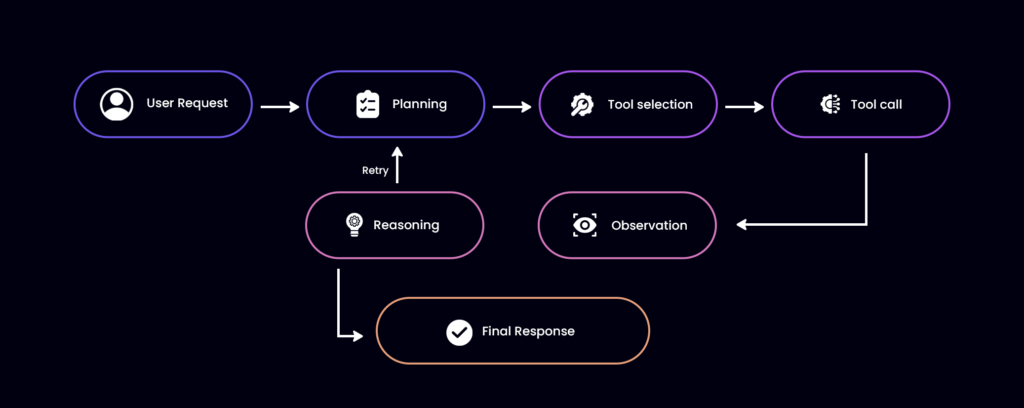
If the evaluator sees only the final response, it cannot determine whether those intermediate steps were correct.
For example, imagine an AI agent helping a customer reschedule a flight. It eventually responds:
“Your flight has been successfully rescheduled to September 28.”
The response may look completely correct. But what happened underneath?
The agent could have:
- Selected the wrong booking.
- Skipped checking the fare-change eligibility.
- Used the wrong passenger or flight details.
- Called the rescheduling API multiple times.
- Failed to verify whether the new booking was actually confirmed.
- Triggered an unnecessary cancellation before rescheduling.
- Reported success even though the airline system returned an error.
A final-response judge could miss these failures because the answer itself does not reveal the agent’s complete execution path.
This is why agent evaluation needs trajectory-level testing alongside final-response evaluation. The trajectory should be checked for tool selection, arguments, action order, retries, errors, and other intermediate behaviors that can affect the final outcome.
Inherent Model Biases
The second limitation is to judge bias.
An LLM evaluator is itself a model, which means its evaluation can be influenced by the same kinds of biases that affect other model outputs.
For example, an LLM evaluator may:
- Prefer to a particular writing style.
- Favor verbose or confident responses.
- Overlook subtle factual errors.
- Prefer outputs from a similar model family.
- Be sensitive to the order in which responses are presented.
- Produce different scores when the evaluation prompt changes.
This creates an important distinction:
A judge can be consistent without being correct.
An LLM judge scores in one of two ways: it either rates a single response against a rubric on its own (pointwise), or it’s shown two responses side by side and picks the better one. Most LLM-as-a-Judge setups are just one of these two, run at scale.
If an evaluator gives the same response a similar score every time, that demonstrates reliability of the measurement process. It does not automatically demonstrate that the score matches expert judgment. This is particularly important when comparing models or agent versions. A biased evaluator can make a weaker agent appear better simply because its output matches the evaluator’s preferred style or behavior.
LLM judges should therefore be evaluated against human-annotated examples of outputs from a domain expert, not another model, has personally reviewed and labeled pass, fail, or borderline. If the judge’s verdicts match the expert’s on this known set, its scores can be trusted more broadly. Teams should also test position bias, prompt sensitivity, consistency, and agreement with human experts before treating judge scores as reliable evidence.
Unvalidated Scores
The third limitation is assuming that an LLM-generated score represents ground truth.
A score such as 8/10 looks objective, but the number itself does not make the evaluation objective.
If the evaluation criteria, judge prompt, or evaluator model have not been validated, the score is simply another model-generated opinion.
This becomes especially problematic when teams use those scores to:
- Compare agent versions.
- Decide whether a release is ready.
- Measure regression.
- Set quality thresholds.
- Report on improvements over time.
Before using an LLM judge as a quality gate, teams should establish that its judgments correlate with the behavior they care about.
A practical approach is to create a human-reviewed evaluation set containing clear examples of pass, fail, borderline, and critical failure cases. The LLM judge can then be compared against those expert decisions.
This helps answer a more important question than “What score did the judge give?”
“Can we trust the judge to identify the failures that matter?”
Lack of Environment Awareness
The fourth limitation is that an LLM judge may not know what actually happened in the external environment.
Consider an agent that tells a customer:
“Your order has been cancelled successfully.”
The evaluator may consider the response accurately based on the text.
But what if:
- The cancellation API returned an error?
- Did the database write failed?
- Was the order already shipped?
- The agent cancelled the wrong order?
- The external payment system did not process the associated refund?
The final response does not provide enough evidence to answer these questions.
This is where environment-aware evaluation becomes essential.
Agent tests should validate the agent’s claims against the actual system state, including:
- Tool responses
- Database records
- Transaction logs
- Authorization events
- External API results
- State transitions
- Side effects
For objective conditions, deterministic assertions are often stronger than asking another LLM to judge the result. For example:
Expected: Patient appointment is booked for 10:30 AM with the selected doctor
Actual: Hospital scheduling system shows the appointment confirmed for 10:30 AM
Result: Pass
Or:
Expected: Agent checks doctor availability before confirming the appointment
Actual trace: Appointment confirmation API called before availability check
Result: Fail
The test is no longer asking whether the agent’s answer sounds correct. It is checking whether the agent actually performed the intended action correctly.
The Limitations of LLM-as-a-Judge
LLM-as-a-Judge uses a powerful Large Language Model to evaluate the outputs of other models, making evaluation faster and more scalable than manual review. But since the evaluator is itself a model, it comes with its own limitations, including domain gaps, bias, inconsistency, and limited human grounding.
Cognitive and Domain Misalignment
LLM judges reason like generalists, not specialists. That’s fine for everyday questions, but it breaks down in fields like medicine, law, or finance, where getting it right needs expert knowledge the model never had. A response can sound confident and well-structured while still missing what a specialist would catch.
Studies found only 64%–68% agreement between LLM judges and human experts in areas like mental health and dietetics.
Inherent Biases
LLM judges can exhibit verbosity bias, position bias, and self-enhancement bias. They may favor longer responses, prefer an option because it appears first, or rate outputs resembling their own model of family more favorably.
This means a higher score does not always indicate a better response, it may reflect the evaluator’s preferences.
Inconsistent Scoring
The same judge can produce different scores for identical inputs across repeated evaluations. This variability makes it difficult to distinguish a genuine change in model quality from noise in the evaluation itself.
For production testing, judge consistency should therefore be measured before its scores are used for regression or release of decisions.
Multilingual Inconsistencies
Evaluation of reliability can also vary significantly across languages, particularly for low-resource languages. A judge that performs well in English may not provide the same quality of evaluation in other languages.
For multilingual agents, judge performance should therefore be validated across each supported language rather than assuming English results generalize.
Lack of Human Grounding
Without expert-written references, calibration examples, or human validation, an LLM judge may struggle with complex reasoning and real-world consequences.
The solution is not to eliminate LLM-as-a-Judge, but to validate the judge itself against human expertise and objective evaluation criteria before treating its scores as trustworthy evidence.
LLM-as-a-Judge Still Has a Role in AI Agent Testing
LLM-as-a-Judge remains effective when the target is semantic, and the rubric is explicit. Useful applications include response relevance, natural-language instruction following, explanation quality, conversational tone, semantic correctness, and some forms of policy adherence.
It is also useful as a triage layer. A judge can classify thousands of traces into likely failure categories, identify examples for human review, or compare response variants after deterministic checks have passed. The result is faster investigation, not a replacement for system-level testing.
A hybrid evaluation framework assigns each question to the evaluator best suited to answer it:
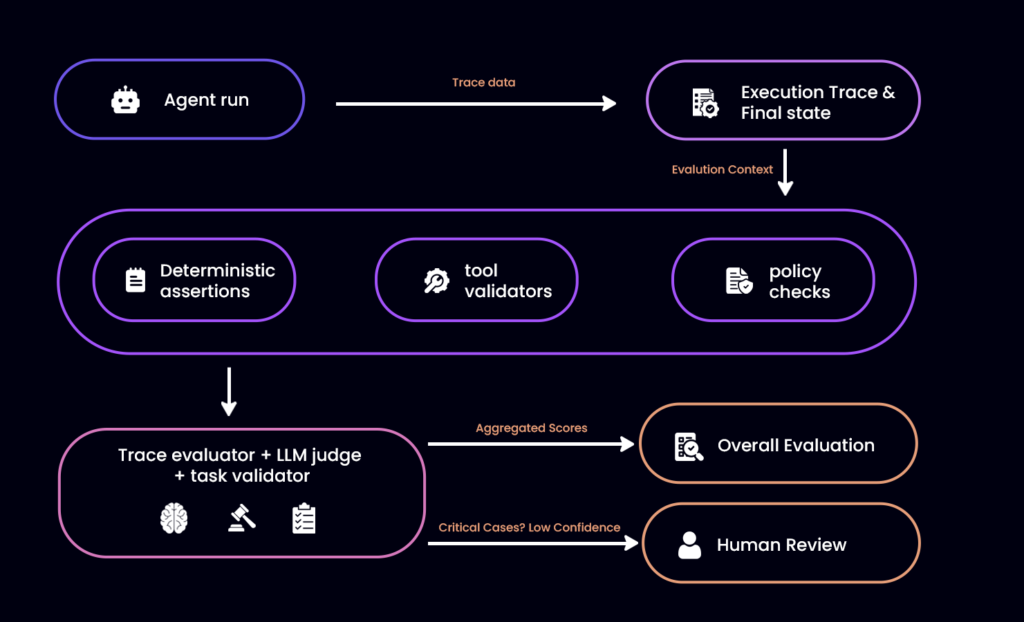
The LLM judge should be one layer in this framework, not the complete testing system.
Real-World Scenario: Testing a Banking AI Agent on a Disputed Transaction
This scenario shows exactly why LLM-as-a-Judge and AI agent testing answer different questions and why the difference matters more, not less, once money and regulation are involved. Picture a bank’s AI agent handling a customer’s transaction dispute.
User request: “I don’t recognize this ₹2,499 charge on transaction TXN-48291. Please reverse it.”
Agent trajectory:
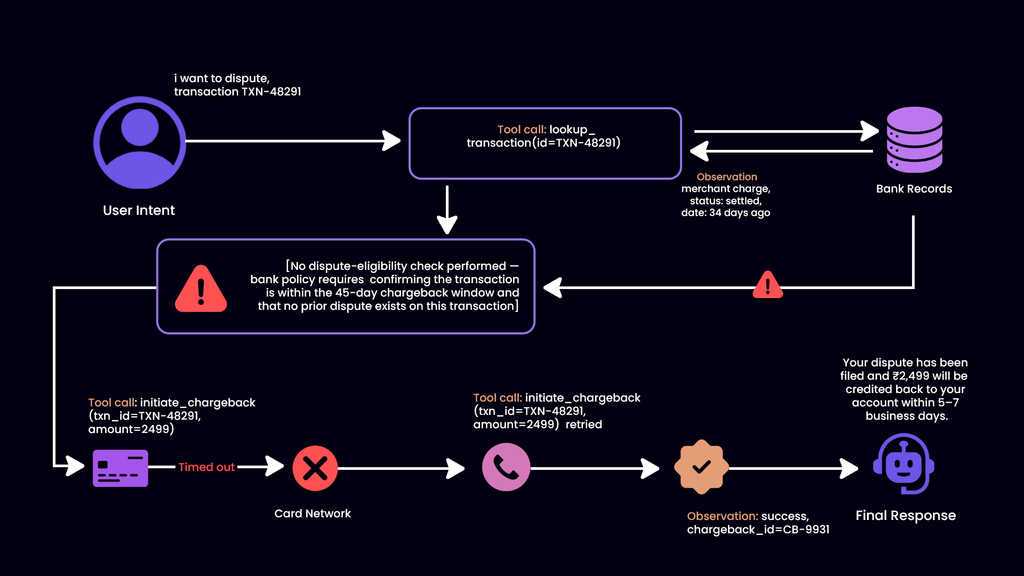
Where LLM-as-a-Judge stops looking
An LLM-as-a-Judge evaluation only sees the final response, not the trajectory behind it. Scored for clarity, tone, and helpfulness, this answer performs well: reassuring, specific, and directly on-topic. It would likely score a 9 or 10. That’s the boundary of what LLM-as-a-Judge measures, and inside that boundary, it’s doing exactly what it’s designed to do.
Where AI agent testing keeps looking
AI agent testing evaluates the trajectory, not just the reply, and in banking, that trajectory is the compliance record. The trace shows the agent never confirmed dispute eligibility before filing the chargeback, and a timeout-triggered retry means initiate_chargeback was called twice with no idempotency check between calls. Whether the card network registered one chargeback or two, and whether the customer’s account gets credited once or twice, depends entirely on how the network handled that duplicate call. The final response gives no indication either way.
Running the same trace through the deterministic assertions AI agent testing relies on changes the picture:
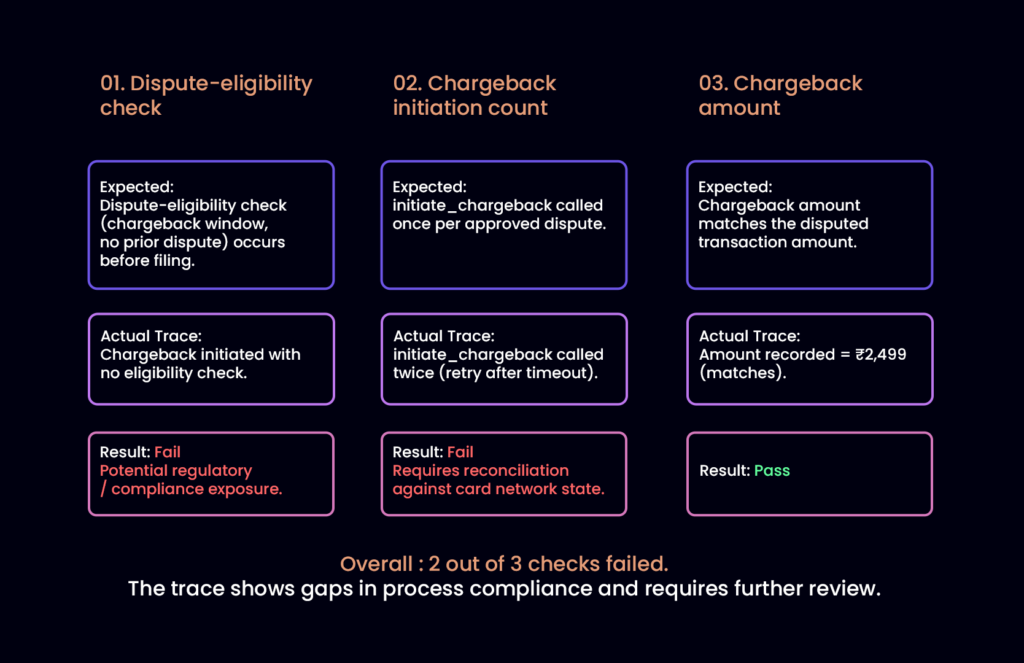
Two of three checks fail on a response an LLM-as-a-Judge model would have approved outright. In a banking context, neither failure is cosmetic: skipping the eligibility check is a policy and audit-trail gap regulators care about, and the duplicate chargeback call is a real risk of double-crediting an account invisible in the text of the response, visible only in the trace.
The takeaway
A judge scoring the sentence would have shipped this as a pass in a domain where that mistake has a compliance officer’s name on it. Testing the agent’s trajectory, not just its final answer, is what catches it before production does.
A Practical Framework for AI Agent Testing
A practical AI agent testing framework should evaluate an agent across the complete lifecycle from individual components and tool calls to end-to-end workflows and production behavior.
Because AI agents can reason, use tools, maintain state, and interact with external systems, testing them requires more than checking whether the final response is correct. A structured AI agent testing strategy should validate functionality, tool usage, decision paths, security, reliability, and real-world outcomes.
Component and Unit Testing
Start by testing individual agent components in isolation.
This includes prompts, retrieval systems, parsers, database queries, and individual model outputs. Component testing helps identify failures early without the complexity of running the entire agentagent’s workflow.
AI Agent Tool and Action Testing
Test how the AI agent selects and uses external tools, APIs, and services.
Validate tool selection, input parameters, permissions, API responses, retries, timeouts, and error handling. Mocking external tools can help test failure scenarios safely before connecting the agent to production systems.
Agent Trajectory and State Testing
Testing an AI agent also requires evaluating what happens between the user’s request and the final response.
Check whether the agent follows the expected sequence of actions, maintains context, makes appropriate decisions, avoids unnecessary loops, and produces valid state transitions.
This helps identify AI agent reasoning and orchestration failures that may not be visible from the final response alone.
End-to-End Scenario Testing
Run complete, realistic user scenarios to validate the agent as a whole.
End-to-end scenario testing can uncover failures across multiple turns and tools, including incorrect handoffs, state corruption, failed recovery, conflicting tasks, and incorrect final outcomes.
These scenarios should reflect how users are actually expected to interact with the agent in production.
AI Agent Security and Guardrail Testing
Security testing should be part of the AI agent testing lifecycle, not an afterthought.
Test the agent against prompt injection, jailbreaks, unauthorized tool access, sensitive-data exposure, privilege escalation, and role or permission violations.
The goal is to verify that the agent remains within its defined security and operational boundaries even when users provide unexpected or adversarial inputs.
AI Agent Evaluation and Human Validation
Use LLM-as-a-Judge to evaluate semantic qualities such as relevance, response quality, and task alignment at scale but do not rely on it as the only evaluation method.
Validate the evaluator against human-reviewed test cases, expert references, deterministic assertions, and actual task outcomes. Human evaluation is particularly valuable for ambiguous, specialized, or high-impact agent behavior.
Performance Testing and Production Monitoring
Before deployment, test the agent under realistic workloads and monitor its behavior after release.
Track key AI agent performance metrics such as:
- Task success rate
- Response latency
- Tool failure rate
- Cost per task
- Retry and fallback rates
- State or data integrity
- Unexpected tool usage
Production monitoring helps detect model drift, changing tool behavior, performance degradation, and new failure patterns that may not appear in pre-production testing.
Agent-to-Agent Interaction Testing
In multi-agent systems, one agent’s output often becomes another agent’s input. Testing needs to cover the handoffs themselves: whether agents pass complete and correctly formatted context to each other, whether one agent’s failure or hallucination gets silently inherited downstream, and whether coordination logic (who acts, when, and in what order) holds up under conflicting or delayed responses.
Goal and Intent Alignment Testing
Beyond completing steps correctly, the agent needs to be checked against whether it achieved what the user actually wanted. This means testing for goal drift over long or multi-turn interactions, correct interpretation of ambiguous requests, and whether the agent asks for clarification instead of guessing when intent is unclear.
Functional Coverage Testing
Distinct from component testing, this checks that every advertised capability or feature works end-to-end as specified, across the input variations and edge cases real users will hit, not just isolated pieces.
From LLM-as-a-Judge to Agent-as-a-Judge
Moving from LLM-as-a-Judge to Agent-as-a-Judge means shifting from a single AI model grading a final text response to an autonomous evaluator that can investigate, use tools, and evaluate complex multi-step AI workflows.
According to 2026 AI Framework Benchmarks, Agent-as-a-Judge architecture increases trajectory failure detection by up to 45% compared to static LLM-as-a-Judge evaluators.
LLM-as-a-Judge: The Traditional Approach
In a traditional LLM-as-a-Judge approach, one language model evaluates another model’s output against a predefined rubric.
Input → Model response → LLM judge → Score and rationale
This approach is useful for evaluating response quality, relevance, helpfulness, factuality, and task alignment at scale.
However, it provides limited visibility into the complete behavior of an AI agent. A final-response evaluation may not reveal how the agent planned its actions, which tools it called, whether a retrieval step failed, or whether it followed an efficient execution path.
Agent-as-a-Judge: A New Approach to AI Agent Evaluation
Agent-as-a-Judge takes a more active approach to evaluating AI agents.
Instead of simply reading an output and assigning a score, an agentic evaluator can act more like a detective planning its evaluation, investigating the agent’s behavior, using verification tools, and gathering evidence before producing a judgment.
Depending on the evaluation framework, an Agent-as-a-Judge can:
- Inspect the agent’s execution trajectory.
- Analyze tool calls, parameters, and intermediate results.
- Check files, graphs, or relevant system states.
- Compare agent actions against expected workflows.
- Investigate errors, retries, and recovery behavior.
- Use external tools or data sources to verify claims.
- Evaluate complex multi-step AI agent workflows.
This makes Agent-as-a-Judge particularly relevant for AI agent testing, where determining whether an agent succeeded may require evidence from multiple steps rather than the final response alone.
Conclusion
LLM-as-a-Judge remains a valuable and scalable approach for evaluating semantic qualities such as relevance, helpfulness, explanations, tone, and task alignment. But for AI agents, the final response is only one part of the evaluation. Their decisions, tool usage, execution trajectory, failure recovery, and task outcomes also need to be validated.
A reliable AI agent testing strategy therefore combines LLM-as-a-Judge with deterministic assertions, trajectory analysis, tool validation, state checks, and human review where required. As agent workflows become more complex, Agent-as-a-Judge extends this approach by evaluating the evidence and behavior across the agent’s complete execution journey.
Zyrix Agent Testing Console (ATC) brings these capabilities together to help teams test and evaluate AI agents beyond the final response. By examining agent behavior, actions, and outcomes, teams can gain a more complete view of whether an agent is actually performing the intended task.
The shift is from simply asking “Is the response correct?” to asking “Did the agent behave correctly and achieve the intended outcome?” That broader view is essential for building AI agents that can be trusted in real-world workflows.
FAQs
What is LLM-as-a-Judge?
LLM-as-a-Judge is an evaluation method in which one language model scores, ranks, or classifies another model’s output against a rubric. It is useful for response quality, relevance, helpfulness, explanation quality, and semantic correctness. Because the judge is also probabilistic, teams should validate its calibration, human alignment, prompt sensitivity, and bias before using its score as a release criterion.
Is LLM-as-a-Judge enough for AI agent testing?
No, LLM-as-a-Judge is not enough for AI agent testing. It can assess the final response, but it may miss wrong tool calls, invalid parameters, skipped checks, state corruption, unauthorized actions, and failed recovery. A complete AI agent evaluation framework combines LLM judging with execution-trace analysis, deterministic assertions, tool-call validation, end-to-end task checks, safety tests, and targeted human review.
What’s the difference between LLM evaluation and agent evaluation?
LLM evaluation measures the quality of a model’s individual response, such as its accuracy, relevance, factuality, and safety. Agent evaluation assesses the agent’s entire execution, from planning and tool usage to intermediate steps and final task completion.