

Blog

AI Agent Testing: The Complete Guide to Testing AI Agents
Key Takeaways
- AI agent testing is beyond checking whether the output looks right, it includes testing AI agents across different dimensions to ensure they complete tasks reliably, safely, and correctly in the real world without causing any mishaps in the production.
- Traditional software testing doesn’t work for AI agents as they behave probabilistically in nature, a single test run cannot give you the holistic picture of how the Agent is behaving. So, to check an AI Agents true reliability it is important to test it across multiple dimensions.
- Explore what can be the proven AI agent testing framework to follow before launching your AI Agents into production.
- Zyrix’s Agent Testing Console, ATC, brings a five-step process approach, which includes evaluating AI Agents across several dimensions. It gives you a clear Go or No Go production readiness verdict backed by an evidence trail, rather than a subjective score.
Introduction
AI Agent testing is becoming crucial as agents are moving beyond experimentation into enterprise workflows making autonomous decisions, on behalf of users. Gartner predicts that up to 40% of enterprise applications will include task-specific AI agents by the end of 2026.
As agents become more autonomous, organizations need to know whether they can complete tasks reliably, choose the right actions, perform according to predefined goals, use tools safely, and stay within defined boundaries. Traditional software testing and single-response LLM evaluations are not enough to validate AI Agents behaviors.
This is where AI agent testing, evals, and guardrails come in. This guide explores how to evaluate agent features & functionalities, outcomes and trajectories, measure performance, test security and tool use, implement runtime guardrails, and build continuous testing into CI/CD and production.
What Is AI Agent Testing?
AI agent testing is the process of evaluating autonomous, AI-driven systems to ensure they work according to their goals, reliably, safely, and correctly before they are deployed.
As a result, AI agent testing focuses not only on whether the final output is correct, but also on how the agent reaches that outcome including its reasoning, tool selection, execution path, hallucinations, reliability, safety, and ability to recover from unexpected situations.
Why Is Testing AI Agents Different from Traditional Software Testing?
Testing AI agents is more complex than traditional software testing because agents can make decisions dynamically based on the task, context, intermediate results, and available tools.
Traditional software tests typically define expected outputs or execution paths for a given input. AI agents, however, may use different tools, make different intermediate decisions, or follow different sequences of actions across multiple trials while still successfully achieving the intended goal.
Testing therefore needs to determine whether each response and execution path is valid, reliable, and aligned with the agent’s objective, not simply whether it matches a single predefined result.
The difference becomes even more significant when an agent must reason across multiple steps, select the appropriate tools, interact with external systems, and adapt its actions as the situation changes.
Therefore, testing should assess both the quality of the agent’s output and the reliability and safety of its ability to achieve that outcome.
Key Differences in AI Agent Testing vs Traditional Software Testing
1. Deterministic vs. Probabilistic Behavior
Traditional Software Testing:
Traditional software testing follows predefined logic, so the same input under the same conditions generally produces the same output. Testing can therefore rely on fixed expected results and repeatable execution.
AI Agent Testing:
AI agents testing use probabilistic models, so the same request can produce different reasoning paths, tool calls, or responses across runs. Testing focuses on whether these variations remain within an acceptable range while still achieving the intended outcome.
2. Pass/Fail vs. Success Probability
Traditional Software Testing:
Traditional software testing typically uses a binary pass/fail model by comparing the actual result with the expected result. A failed test usually indicates a specific deviation or defect.
AI Agent Testing:
AI agent testing evaluates reliability across multiple executions rather than relying only on a single pass/fail result. Metrics such as task completion rate, step success rate, tool-call accuracy, failure rate, and cost per task help measure how consistently the agent succeeds.
This means AI agent testing measures how reliably an agent performs over time, not just whether one execution passes or fails.
3. Static Test Scripts vs. Dynamic Decision-Making
Traditional Software Testing:
Traditional Software Testing follows a predefined sequence of test steps, with each step and expected result explicitly defined in advance. The test verifies whether the application executes that expected flow correctly. If the application deviates from the defined sequence or produces an unexpected result, the test can flag it as a failure.
AI Agent Testing:
AI agents testing choose different actions and execution paths based on the task, context, and results they receive along the way. A different path does not necessarily mean the agent has failed if it still reaches the correct outcome safely and efficiently. Testing therefore needs to determine which actions are required, which variations are acceptable, and whether the agent’s decisions remain valid throughout the task.
This shifts testing from validating one predefined workflow to validating whether different execution paths still produce a correct and controlled outcome.
4. Single Outputs vs. Multi-Step Trajectories
Traditional Software Testing:
Traditional software testing often validates a specific function, API response, or transaction independently. The test checks whether the input produces the expected output, with limited dependency on what happened in previous test steps.
AI Agent Testing:
AI agent testing often completes one task through multiple connected steps, where the result of one action becomes the input for the next. Testing therefore needs to verify each important step, including whether the agent selected the right tool, passed the correct parameters, interpreted the response correctly, and maintained the right context throughout the task. A failure in one step can affect every step that follows
This means AI agent testing needs to examine every important decision and action that contributes to the final outcome.
5. Conventional Bugs vs. Emergent Agent Failures
Traditional Software Testing:
Traditional Software testing focuses on issues such as incorrect logic, broken integrations, invalid inputs, and functional defects. These issues are usually tied to specific application components and can be identified through defined test cases.
AI Agent Testing:
AI agent testing also needs to consider behavioral and security risks such as hallucinations, incorrect decisions, goal drift, tool misuse, prompt injection, unauthorized actions, and context failures. These failures can depend on the agent’s inputs, decisions, interactions, and execution context, making them harder to detect through conventional functional tests alone.
This means AI agent testing needs to evaluate not only whether the system works as designed, but also how the agent behaves when faced with unexpected or adversarial situations.
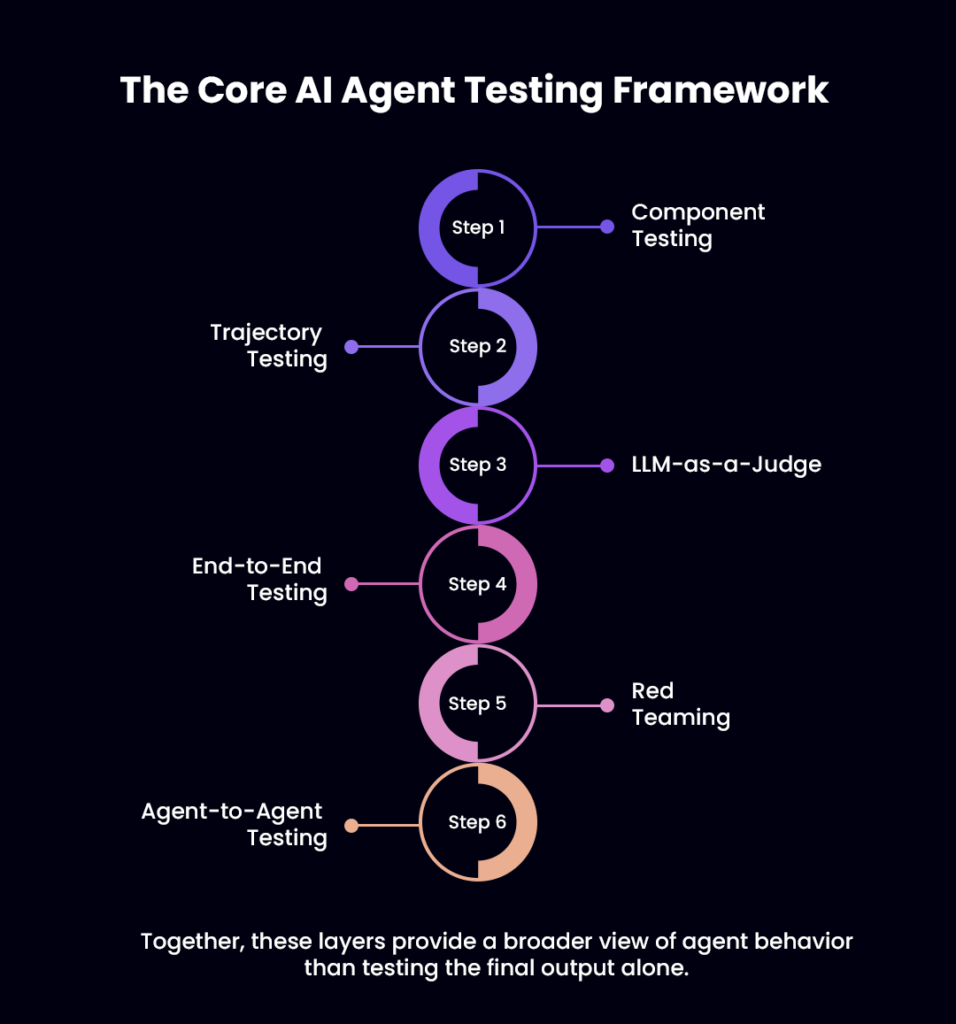
Key Components of an AI Agent Testing Framework
An effective AI agent testing framework evaluates how an agent makes decisions, uses tools, handles context, and completes tasks across different execution paths. Let’s break down the key testing layers involved.
1. Component Testing
Test individual aspects of the agent separately before testing the entire workflow.
This includes testing:
- Tool selection
- Parameter formatting
- Memory retrieval
- Individual agent components
Component testing helps identify problems early, before they become part of a larger multi-step failure.
2. Trajectory Testing
Trajectory testing measures the agent’s multi-step process to accomplish a task.
Rather than just considering the final response, consider whether the agent:
- Identifies the appropriate tools
- Follows appropriate procedure
- Passes valid parameters
- Uses an intermediate calculation accurately
- Achieves the expected goal
This is important because an agent can arrive at the correct result while making incorrect decisions during the process.
3. LLM-as-a-Judge
An additional model can evaluate an agent’s responses against a predefined evaluation rubric.
LLM-as-a-Judge can be used to evaluate aspects like:
- Response quality
- Accuracy
- Relevance
- Tone
- Instruction following
The method is especially effective if the outcome that is expected cannot be effectively determined by deterministic statements.
4. End-to-End Testing
End-to-end testing verifies the agent’s performance in an authentic user-focused objective and entire workflow.
The whole process of the interaction, from the request of the user until the result of the agent is assessed.
This can uncover defects not identified by the component tests.
5. Red Teaming
Red teaming tests the agent under adversarial and out-of-scope conditions rather than expected ones deliberately probing for prompt injection, jailbreak attempts, unauthorized actions, and harmful or out-of-bounds requests. Unlike the other layers, which check whether the agent does its job correctly, red teaming checks whether it can be manipulated into doing something it shouldn’t.
6. Agent-to-Agent Testing
Many real-world systems involve multiple agents coordinating with each other, where one agent’s output becomes another’s input a failure in one can propagate through the entire chain.
Zyrix treats this as its own testing dimension, verifying collaboration, context preservation, and reliable execution across multi-agent workflows through a five-step process: Discover the agent’s configured features and tools, generate realistic multi-turn scenarios, validate performance under simulation, Release with a clear Go/No-Go verdict, and repeat to catch drift over time.
This extends trajectory testing to a multi-agent setting, tracking how context passes correctly between agents, not just within one.
Outcome vs. Trajectory: What Should You Evaluate?
You should evaluate both outcome and trajectory because the outcome tells you whether the agent achieved its goal, while the trajectory shows how it got there. If you only measure the result, you can mask significant failures for AI agents that have some tools, make decisions, and change external state.
Outcome evaluation is most useful for tasks with a clearly defined success state, such as a calculation, a database update, or a completed transaction, where the end result is what matters most. But it can miss inefficient or unsafe actions the agent took to get there.
Trajectory evaluation examines the agent’s sequence of actions, including tool calls, intermediate results, and decisions. It can be especially valuable when there is a complex workflow, and selecting the right tool, ensuring safety, efficiency, and quality of execution are important factors. Currently, LangChain guidance supports both deterministic trajectory matching and LLM-based trajectory judges, depending on how strictly the expected path needs to be defined.
| Evaluation | Best for |
| Outcome | Verifying whether the goal was achieved |
| Trajectory | Evaluating how the agent reached the goal |
| Both | Complex enterprise workflows where both result and execution matter |
AI Agent Evaluation Metrics: What Should You Measure?
You should measure more than whether an AI agent completes a task. There is more emphasis on task success, tool accuracy, trajectory efficiency, groundedness, safety, latency, cost, and consistency during the evaluation of agents in 2026, because a correct final answer might be the product of an inefficient or risky execution path.
The need for broader evaluation is clear as agent capabilities improve. Stanford HAI’s 2026 AI Index, cited by Snowflake, reports that agent performance on OSWorld increased roughly 12% to 66.3%. Yet agents still fail approximately one in three attempts, showing why benchmark or final-answer accuracy alone is not enough to establish production reliability.
Key metrics for assessing core AI Agent capabilities
The following core metrics give teams a consistent way to measure agent capability across different tasks and use cases:
- Task Success Rate
Measures the percentage of tasks an agent can complete and finish successfully. It is the most common outcome measure but should be used in conjunction with trajectory and safety measures.
- Tool Call Accuracy
Determines if the agent chooses the right tool, gives valid arguments, and applies the tool properly. A first-class signal for evaluating agent’s tool use: using a tool incorrectly can cause downstream problems to use tools: using a tool incorrectly can lead to problems downstream.
- Trajectory Efficiency
Measures how efficiently the agent reaches its goal, accounting for unnecessary steps, repeated tool calls, retries, and inefficient execution paths. Although it may seem obvious, it is not always desirable to have a shorter trajectory, steps may be legitimately required for verification and/or error recovery.
- Groundedness
Determines if agent’s answers and decision-making is substantiated by the retrieved context, authorized data or tool outputs. This is particularly important for enterprise agents working with business or knowledge-based data.
- Context Preservation / Handoff Accuracy
Measures whether context, state, and intent survive intact as a task moves from one agent to another. In multi-agent workflows, one agent’s output becomes another’s input. If information is dropped, misinterpreted, or altered in the handoff, the failure propagates through the rest of the chain even if each individual agent performed correctly in isolation
Operational & Safety Metrics
- Latency
Tracks how long the agent takes to perform an action. For multi-step agents, measure latency at the tool-call and step level too, not just for the overall task
- Token Usage and Cost per Task
Cost Efficiency tracks the number of tokens, model calls, tool calls, and compute/API usage required to complete a task. An agent that’s highly accurate but expensive to run may still be unsuitable for production if the cost outweighs the value it delivers.
- Safety and Compliance
This metric evaluates whether the agent complies with policies, respects permissions, avoids unauthorized actions, and defends against attacks like prompt injection. Safety should be built into the agent’s design from the start, not treated as an add-on.
- Consistency and Reliability
Repeat the same scenario multiple times since an agent’s behavior can differ from run to run. Monitor pass rate, trajectory variation, consistency of the tool and failure patterns, and not just a successful pass. Anthropic’s 2026 guidance specifically recommends multiple trials when evaluating agent behavior.
AI Agent Metrics at a Glance
| Metric | What It Measures | Why It Matters |
| Task Success Rate | Whether the goal was achieved | Measures overall effectiveness |
| Tool Call Accuracy | Correct tool and arguments | Identifies execution errors |
| Trajectory Efficiency | Steps, retries, and tool usage | Reveals inefficient behavior |
| Groundedness | Support from valid context/data | Reduces unsupported outputs |
| Latency | Time to complete a task | Measures responsiveness |
| Cost per Task | Resources required per task | Determines production viability |
| Safety Compliance | Policy and permission adherence | Reduces operational risk |
| Consistency | Performance across repeated runs | Measures reliability |
| Context Preservation | Whether context/state survives agent handoffs | Prevents multi-agent failure propagation |
AI Agent Testing Tools: What Are the Best Options?
AI Agent Testing has gone beyond functional testing, and there are a number of tools to assess agent behaviour, performance, security and reliability. Each platform has different strategies for testing agents, and it’s important to understand what each platform provides before selecting the appropriate solution.
Best AI Agent Testing Tools
- Zyrix
Best For: AI agent testing and production-readiness validation.
Key Features: An AI agent testing platform that maps an agent’s declared features, system prompts, and tool configurations, then generates real-world, multi turn scenarios, including invalid and out of scope requests, to see how the agent actually behaves, not just what it says. It validates tool selection and execution, checks for hallucinations, and runs security and adversarial testing to catch prompt injection, jailbreaks, and unauthorized actions. It also tests agent to agent coordination and full business workflows across tools, APIs, and systems. Every result comes with an evidence trail, state and API data showing exactly what happened, rather than a subjective score, and every test re-runs automatically whenever the model, prompt, or workflow changes. The output is a single Production Readiness Score with a clear Go- or No-Go verdict
- Maxim AI
Ideal for: AI agent simulation, evaluation, and observability across the development and production lifecycle.
Key Features: Provides simulation and evaluation capabilities for testing AI agents across different scenarios, interactions, and workflows. It supports agent performance evaluation, tool-call analysis, tracing, and continuous monitoring to help teams identify issues during development and production. Its primary focus is on evaluating and monitoring AI-agent behavior, rather than broader enterprise software testing across applications and systems.
- TestMu AI (formely LambdaTest)
Ideal for: AI Test Generation and Cross-platform testing.
Key Features: KaneAI plans, authors, executes, and maintains tests from natural language, Jira tickets, Figma files, or screen recordings, then exports the automation as Selenium, Playwright, Cypress, or Appium code. Covers web, mobile, API, database, and accessibility testing, with self-healing steps that re-anchor when the UI changes , but focused on speeding up functional test automation, not on validating an AI agent’s own behavior, decisions, or safety boundaries.
- LangWatch
Ideal for: Simulation-based AI agent testing and evaluation.
Key Features: Tests AI agents through multi-turn simulations that model real user interactions and evaluates complete agent journeys, including tool calls, intermediate steps, and task outcomes. It also supports agent evaluations, red-team scenarios, tracing, and CI-based testing. Its primary focus is on validating agent behavior and reliability across simulated workflows.
- Confident AI
Ideal for: Evaluation and testing of LLM and AI-agent applications.
Key Features: Provides evaluation capabilities for AI agents using metrics, test cases, traces, and multi-turn interactions. Supports testing areas such as task completion, tool use, reasoning, and response quality, while Confident AI provides workflows for running and monitoring evaluations across development and production. Its primary focus is on measuring and validating AI-system behavior, rather than broader enterprise software test automation.
- Rhesis AI
Ideal for: Automated testing and evaluation of LLM and agentic applications.
Key Features: Generates test scenarios and evaluates AI applications through single-turn and multi-turn tests. Supports goal-based user journeys, custom evaluation metrics, test-set execution, and CI/CD integration. Its primary focus is on validating LLM and agent behavior against defined requirements.
| Tool | AI Agent Testing | Tool & Workflow Testing | Security Testing | Evals & Evaluation | Goal Orientation | Best For |
| Zyrix | ✓ | ✓ | ✓ | ✓ | ✓ | Enterprise AI agent testing |
| Maxim AI | ✓ | ✓ | Partial | ✓ | ✗ | Agent simulation & evaluation |
| TestMu AI (Formely LambdaTest) | Partial | ✓ | Partial | Partial | ✗ | AI-powered test automation |
| LangWatch | ✓ | ✓ | ✓ | ✓ | ✓ | Simulation-based agent testing |
| Confident AI | ✓ | Partial | Partial | ✓ | ✓ | LLM & agent evaluation |
| Rhesis AI | ✓ | ✓ | ✓ | ✓ | ✓ | Agent testing & evaluation |
AI Agent Observability and Trajectory Tracing
Evaluating the final answer is not the end of testing an AI agent. AI agent observability and agent trajectory tracing gives visibility into an agent’s actions while performing a task from the tool calls to decisions to handoffs to intermediate actions. This allows teams to determine where and why agents are falling short in a longer, more involved process.
Why Do AI Agents Need Specialized Observability?
Traditional application monitoring can indicate the success of an API request but may not give any idea of whether the agent fulfilled the user’s purpose. AI agents add to the complications:
Non-deterministic behavior: Different execution paths can occur for the same request over different executions.
Semantic failures: An agent could choose the wrong tool or give bad input even if the API itself is returning to a success status.
Multi-step workflows: multiple workflow steps may include multiple model calls, interactions with tools, memory operations, and handoffs between agents.
Key Components of AI Agent Observability
Trajectory Tracing: Records the flow of actions, tool uses, model interactions and handoffs that are required for a task.
Context Capture: Logs relevant inputs, outputs, tool parameters and execution information that is required to understand agent behavior.
Trajectory Evaluation: Evaluates the overall trajectory of execution including task completion, tool usage, and efficiency.
Why Is Trajectory Tracing Important?
When used in conjunction with trajectory tracing, an AI agent’s actions could become an “inspectable workflow.” Teams can determine if the problem was in the selection of the tool, retrieving the data, making the decision, or implementing the decision.
These traces can then be leveraged to enhance the performance of AI agents through various evaluation processes, regression tests, debugging, and ongoing monitoring, ensuring reliable agent performance as models, prompts, tools, and workflows evolve.
How to Run AI Agent Testing in CI/CD
By incorporating AI agent testing into CI/CD, developers can automatically test their agents when they modify them. With version-controlled evaluation datasets, automated evals, controlled releases and deployment thresholds, teams can prevent regressions from getting to production.
Curate a Version-Controlled Evaluation Dataset
Build a golden evaluation dataset containing realistic user scenarios, edge cases, expected outcomes, and safety risks. Keep the dataset with the application code (or link it up to an evaluation platform) and track and review changes to test cases.
The data should be updated with any new failures of agents discovered to make any resulting production problems repeatable for regression tests.
Create an Automated Evaluation Runner
Create an assessment methodology that:
- Loads test scenarios
- Directs them to the AI agent
- Records of pertinent execution traces.
- Critically analyzes the agent’s response and action
- Calculates performance metrics
- Compares results to predetermined thresholds
This enables to maintain the same evaluation process across all evaluation runs, regardless of agent changes.
Integrate Evals Into the CI/CD Pipeline
Set up the CI/CD pipeline to automatically execute agent evaluations on pull requests, model changes, prompt updates, or workflow changes.
A typical workflow looks like:
Code/Prompt Change → Agent Evals → Results → Regression Check → Pass/Fail
If the evaluation results fall within the necessary thresholds, the change can proceed to deployment. If some of the metrics are below the acceptable baseline, the pipeline should flag or block the release.
Establish Guardrails and Deployment Gates
Establish explicit quality standards for key behaviours of the agent.
For example:
- Task success: Must be greater than the defined baseline
- Tool accuracy: No critical tool-use failures
- Safety: No Policy Violations (High Severity)
- But regression: No significant degradation from the previous version
Teams might also look at canary deployments for higher-risk agents to test a new model or the new version on a small percentage of traffic before switching to it.
A Continuous AI Agent Testing Loop
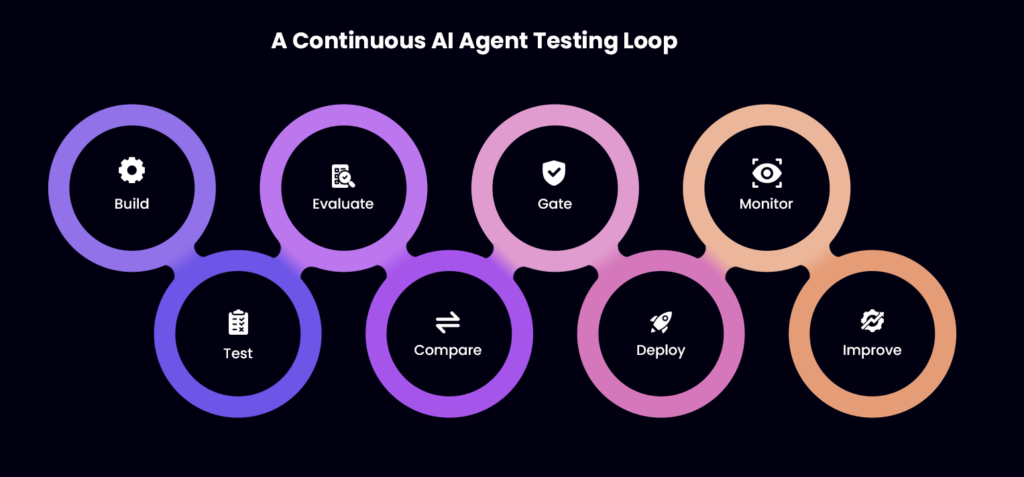
This changes the way AI agent testing is done, moving it from a one-off pre-release activity to a continuous quality process. Evaluation Data Sets, Evaluation Metrics, and Regression Tests should evolve with the agents.
AI Agent Testing in Production
Testing doesn’t end when an AI agent goes live. Production introduces unpredictable user inputs, changing data, tool failures, and new interaction patterns, making continuous evaluation and monitoring essential.
Key production testing practices include:
- Trajectory Evaluation: Assess the agent’s complete execution path, including decisions, tool calls, retrieved context, and final outcomes.
- Production Observability: Capture traces of real interactions to identify failures, latency issues, and unexpected behavior.
- Live Traffic Scoring: Continuously measure task completion, tool-use accuracy, faithfulness, latency, and error rates.
- Production-to-Test Feedback: Convert real-world failures and edge cases into regression tests for future agent versions.
- Safe Rollouts: Use canary or staged deployments with defined performance thresholds and rollback mechanisms.
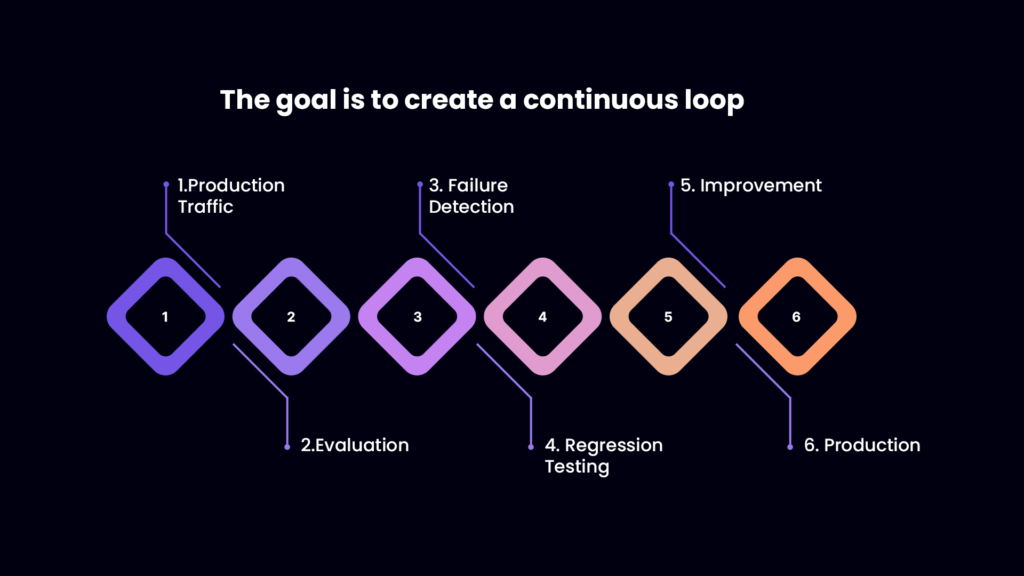
This ensures the agent remains reliable not just at launch, but as its models, tools, data, and user interactions evolve.
How to Build an AI Agent Testing Strategy: Step-by-Step
An effective AI agent testing strategy should evaluate individual components, complete execution trajectories, and real-world task outcomes while accounting for non-deterministic behavior.
Define Success Criteria and Metrics
Establish what successful agent behavior looks like and define measurable targets for accuracy, task completion, latency, cost, and reliability. Identify likely failure modes such as tool misuse, incorrect decisions, and execution loops.
Use Layered Testing
Test the agent at multiple levels:
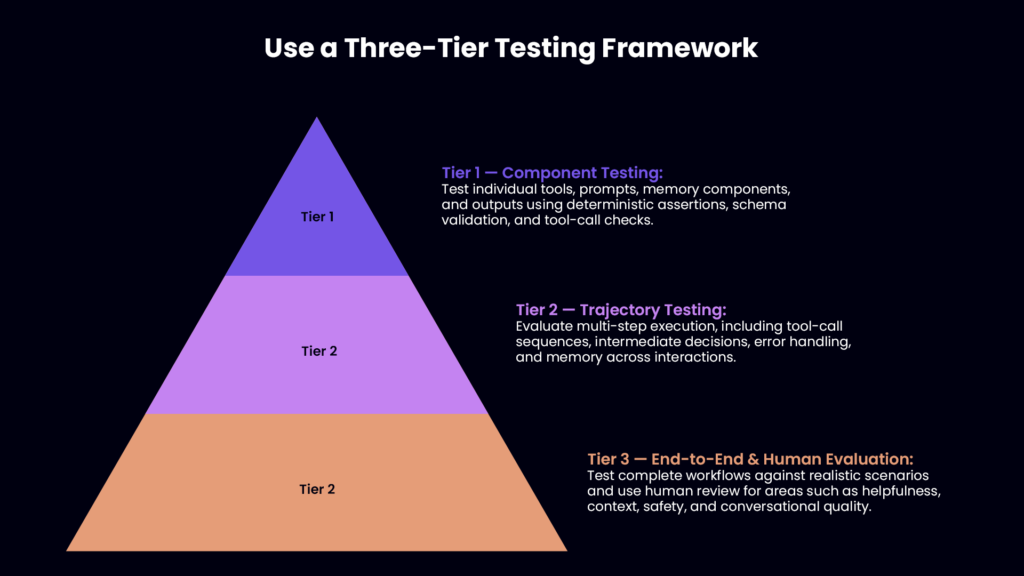
- Component Testing: Validate individual tools, memory, prompts, and sub-agents.
- Trajectory Testing: Evaluate decisions, tool calls, and intermediate execution steps.
- End-to-End Testing: Test complete multi-turn workflows using realistic scenarios.
Automate Evaluation
Use LLM-as-a-Judge alongside deterministic checks to evaluate responses and execution traces against defined rubrics. Re-run critical test scenarios to measure consistency and detect regression.
Add Security and Red-Team Testing
Test agents against jailbreaks, prompt injections, harmful requests, unexpected inputs, and out-of-scope tasks. Include these evaluations in CI/CD so changes to models, prompts, or tools automatically trigger regression testing.
AI Agent Testing Best Practices
With the core testing layers and metrics in place, these best practices help teams apply them consistently as agents scale and evolve in production.
Use a Three-Tier Testing Framework
A practical testing strategy combines fast component checks with deeper trajectory and human evaluations:
Test More Than the Final Output
A correct final answer does not always mean the agent behaved correctly. Evaluate how the agent reached the outcome, including tool selection, parameters, intermediate states, and recovery from failures.
Combine Automated and Human Evaluation
Automated tests provide speed and repeatability, while human evaluation helps identify issues involving nuance, context, safety, and user experience. Use both rather than relying exclusively on one approach.
Continuously Test as the Agent Evolves
Re-run critical evaluations whenever you change the model, prompts, tools, memory, or workflows. Production failures and new edge cases should also become regression tests.
Conclusion:
AI agent testing is what separates a working demo from a system ready for real users. It requires going beyond checking a single output, and instead evaluating the agent’s full trajectory, tool usage, decision making, security, and performance across real-world conditions.
A reliable approach combines component testing, trajectory testing, end-to-end testing, automated evaluations, security testing, and continuous monitoring, extending into CI/CD and production, where real-world failures and edge cases become regression tests for future releases.
The goal isn’t to prove an agent works once. It’s to continuously verify that it keeps working as models, prompts, tools, workflows, and user interactions evolve over time.
Platforms like Zyrix’s Agent Testing Console (ATC) are built around this exact approach, helping teams treat agent testing as a continuous lifecycle of testing, evaluation, monitoring, and improvement, so they can ship AI agents that are more reliable, secure, and genuinely production ready.
Frequently Asked Questions
What are the key metrics for AI agent testing?
The key metrics for AI agent testing include task success rate, tool-call accuracy, trajectory efficiency, groundedness, latency, cost per task, safety compliance, and consistency. Measuring these metrics helps teams determine whether an AI agent is not only producing useful results but also completing tasks efficiently, safely, and reliably.
How do you handle non-determinism when testing AI agents?
You handle non-determinism by running the same scenario multiple times and measuring pass rate, trajectory variation, and failure patterns across trials, rather than judging a single run as a pass or fail.
How is AI agent testing different from LLM evaluation?
LLM evaluation typically scores a single model response against a prompt, while AI agent testing evaluates a full multi-step trajectory tool calls, decisions, memory, and handoffs because an agent’s final answer can look correct even when the process behind it was flawed. Agent testing treats the LLM as one component inside a larger system being tested, not the entire system.